
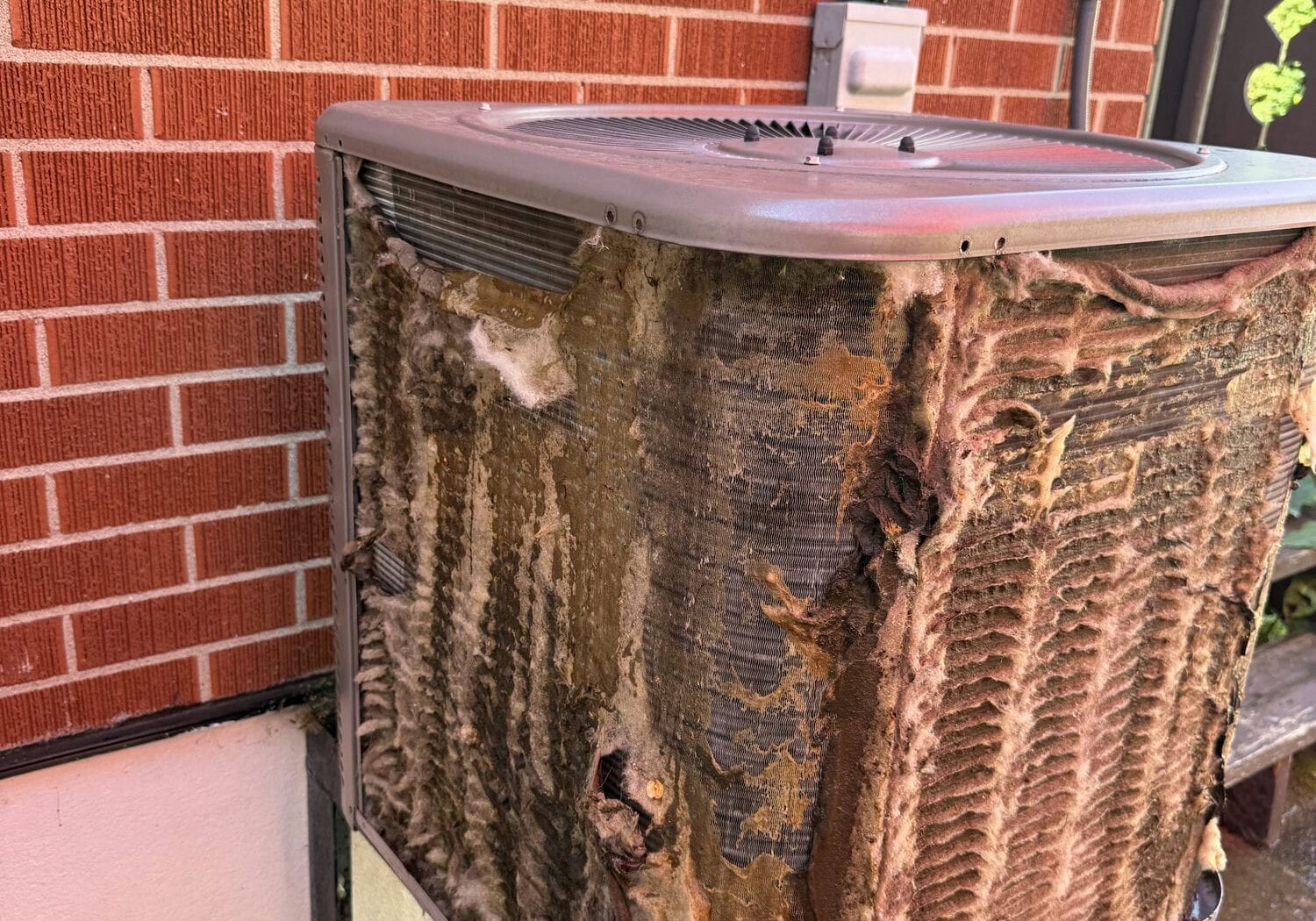
A homeowner called us last week about a rental property in Waterloo. Nothing was broken. The tenant had not complained. The air conditioner was still blowing cold air. They simply wanted maintenance done because it had been a while, and they figured it was probably time. That instinct saved them a compressor. Here is the short version of what we found and why it matters: an air conditioner will keep producing cold air long after it has started destroying itself, and the only way to catch that is to physically look at it. Age has nothing to do with it. Whether your system was put in last spring by an experienced air conditioner installation crew or has been running for a decade, the outdoor unit sits outside collecting whatever the weather blows into it, and after two seasons that adds up to a genuine problem.
This is a real job from this season, with real photos, a real homeowner, and a real outcome. We are walking through it because it demonstrates something we struggle to explain in the abstract: the worst AC problems are the ones that produce no symptoms at all.
The Call: A Waterloo Rental, Two Years Old, No Complaints
The property is a tenant-occupied rental in Waterloo. The air conditioner was installed roughly two years ago, which in the life of a central AC is practically brand new. Most homeowners would not give a two-year-old system a second thought, and honestly, most do not. The unit had never had a maintenance visit since the day it went in.
There was no fault. No error code. No warm air. No strange noise. The tenant was comfortable, the thermostat was hitting setpoint, and from inside the house everything looked completely normal. The owner booked the visit purely as a precaution, which is exactly the kind of call we wish we got more often, because the alternative is the call that comes at four in the afternoon in the middle of a July heat wave when the compressor has finally given up.
We scheduled the appointment, coordinated access with the tenant, and sent a technician out. What we found on the condenser is the whole reason this article exists.
What We Found on the Condenser
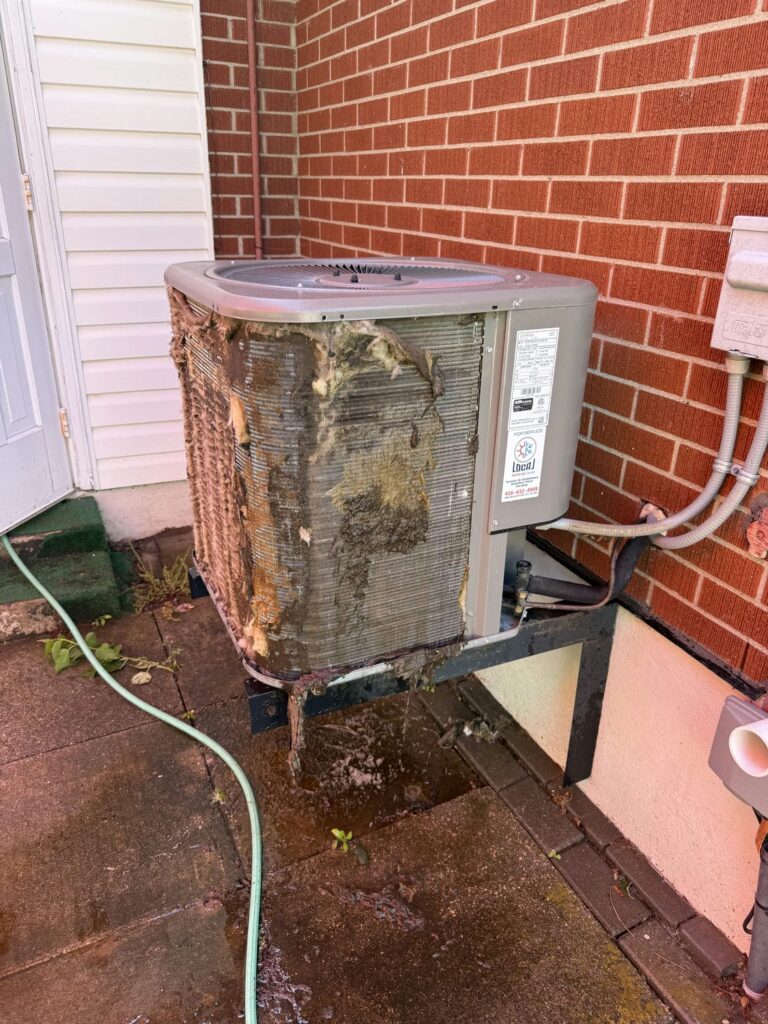
Before Maintenance
Condenser coil of a two-year-old Lennox air conditioner packed with cottonwood fluff and yard debris before AC maintenance at a Waterloo rental property
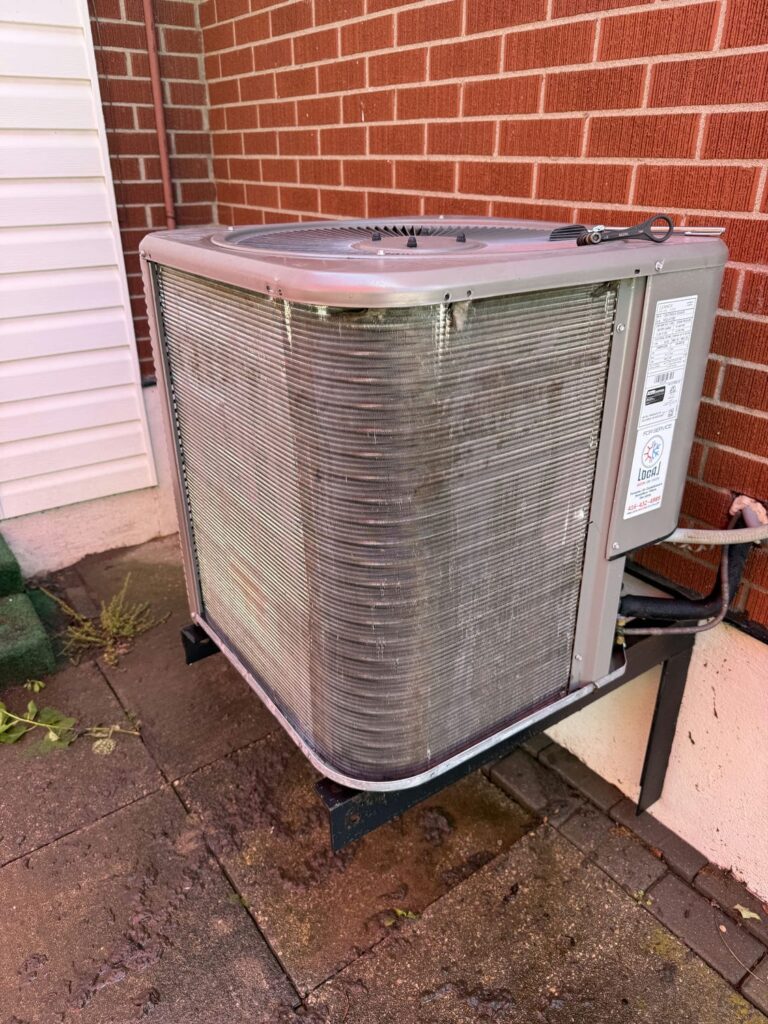
After Maintenance
Same Lennox condenser coil fully cleaned and clear of debris after an AC maintenance visit at a Waterloo rental property
The outdoor condenser unit was packed. Two full seasons of cottonwood fluff, grass clippings, dust, pollen, and general yard debris had worked their way deep into the coil fins and built up around the base of the cabinet. It was not a light dusting. The airflow path through the coil was substantially blocked, and it had been running that way through two entire cooling seasons.
We photographed everything before we touched it, and photographed it again once the coil was clean. The difference was dramatic enough that we sent the whole set to the homeowner while we were still on site. That is standard practice for us, but in this case the before shots did more to explain the value of the visit than any amount of talking would have.
Here is the part that catches people off guard. A condenser in that condition does not announce itself. There is no beep, no flashing code, no shutdown. The compressor keeps running, the refrigerant keeps cycling, and cold air keeps coming out of the vents. From the tenant’s point of view, and from the homeowner’s, the system was working perfectly. It was not.
Why a Dirty Condenser Coil Costs You More Than You Think
To understand why this matters, it helps to know what the outdoor unit is actually for. Your air conditioner does not create cold. It moves heat. It pulls heat out of the air inside your house, carries it outside in the refrigerant, and dumps it into the outdoor air through the condenser coil. Airflow across that coil is the entire mechanism by which the heat leaves. Restrict the airflow and the heat has nowhere to go.
Everything that goes wrong from that point follows from one simple fact: the heat is still in the system, so the system has to work harder and longer to get rid of it.
Longer Run Times and Higher Hydro Bills
When the condenser cannot shed heat efficiently, the air conditioner has to stay on for extended cycles just to bring the house down to the temperature on your thermostat. It is fighting itself the entire time. That means the compressor and both fan motors are drawing power for significantly more hours across the season than they should be.
The insidious part is that this shows up on your hydro bill as a number, not as a symptom. You are paying more, month after month, and there is nothing on the bill that says why. Nobody connects a slightly higher electricity cost in August to a dirty coil in the side yard, because there is no obvious link between the two.
Head Pressure and the Compressor
The compressor is the single most expensive component in your entire cooling system, and it is engineered to operate within a specific pressure range. When the condenser coil cannot reject heat properly, head pressure climbs and stays elevated for the entire run cycle. The compressor is then operating outside its design window, hour after hour, all summer long.
Compressors very rarely fail because of one bad day. They fail because of thousands of accumulated hours of running slightly too hard under slightly too much pressure. That is the mechanism by which a system that should have lasted fifteen years quietly becomes a system that fails in nine. The lifespan of a central air conditioner in Ontario depends far more on accumulated running stress than on the number on the warranty.
The Silent Failure Problem
Every other component in that outdoor unit is also under strain. The condenser fan motor is working harder to push air through a restricted coil. The capacitor is cycling under load more often. The contactor is opening and closing through longer cycles. Each of these parts has a finite service life, and each one gets shorter under sustained stress.
None of this produces a symptom you would notice until a component actually fails. And when a component actually fails, you are no longer paying for maintenance. You are paying for a repair, or in the worst case a replacement, in the middle of the hottest week of the year when every HVAC company in the region is booked solid. That is the real cost of the two-year-old system nobody looked at.
The Rental Property Blind Spot
This case is worth calling out specifically, because the pattern repeats constantly across the rental properties we service in Waterloo, Kitchener, and Cambridge.
When a property is tenant-occupied, HVAC maintenance falls into a gap that neither party is positioned to close. The tenant is not thinking about the long-term health of equipment they do not own. If the air conditioner is producing cold air, it is working, and there is no reason to call anybody. The owner is not at the property, is not looking at the condenser, and has no way of knowing that a unit installed two years ago is now completely choked with debris.
So nothing gets done. Not out of neglect on anyone’s part, but simply because nobody is standing in the position where they would notice. The tenant sees the thermostat. The owner sees the rent. Nobody sees the coil.
If you own a rental in the region, the fix is unglamorous but effective: put AC maintenance on a recurring calendar and book it whether or not anyone has complained. Waiting for a call from your tenant means waiting until the cheap fix has already passed you by. We handle HVAC maintenance across Waterloo on exactly that kind of recurring schedule, so the coil gets looked at before a tenant has any reason to pick up the phone.
What We Actually Did on This Visit
A proper AC maintenance visit is not a technician spraying the outside of the unit with a hose and writing an invoice. There is a defined sequence, and every step of it exists because something specific fails when it is skipped. Here is exactly what happened at this property:
- Cleared all debris from around the base and cabinet of the condenser, and removed the accumulated cottonwood and organic matter that had collected inside the housing.
- Cleaned the condenser coil properly, flushing the fins from the inside out so the debris is pushed back out the way it came in rather than driven deeper into the coil.
- Checked the refrigerant charge against the manufacturer’s specification for that unit, because a system running low is a system running its compressor lean.
- Tested the run capacitor under load to confirm it was still within its rated microfarad tolerance, since a weak capacitor is the single most common cause of a no-start call.
- Inspected the contactor for pitting and burning on the contacts, which is a slow failure that eventually welds shut or refuses to close.
- Verified all electrical connections and checked for loose lugs, which arc, overheat, and take out control boards.
- Confirmed the condenser fan motor was spinning freely and drawing correct amperage, not straining against a restricted coil.
- Checked the condensate drain and pan on the indoor side to confirm nothing was backing up.
- Measured system amp draw and confirmed the unit was operating within specification once the coil was clean.
- Photographed the entire job before and after, and sent the complete set to the homeowner with a written summary.
The response from the owner was immediate, and it was mostly relief. The tenant was pleased as well, because the house now comes down to temperature noticeably faster on hot days. The system was recovering heat properly for the first time in two years. Nobody got an emergency invoice. Nobody was without air conditioning. We caught the problem while it was still a maintenance problem instead of waiting for it to become a compressor problem.
What Maintenance Buys You, Step by Step
It is worth laying out plainly what each part of that checklist is actually protecting you against, because the value of maintenance is almost entirely invisible until the moment it is not. Every item below shares the same pattern: nothing appears to be wrong, right up until something expensive is.
| What You Skip | What It Looks Like Day to Day | What It Costs You Eventually |
| Condenser Coil Cleaning | Nothing. The AC still blows cold. | Longer run cycles, higher hydro bills, compressor strain over thousands of hours. |
| Capacitor Testing | Nothing, until the day it will not start. | A no-cool emergency call in a heat wave instead of a ten dollar part swapped during a scheduled visit. |
| Refrigerant Charge Check | Slightly less cooling. Most people never notice. | A slow leak running the compressor lean, which is one of the fastest ways to kill it. |
| Electrical And Contactor Inspection | Nothing visible from inside the house. | Pitted contacts and loose lugs that arc, overheat, and take out the board. |
| Condensate Drain Clearing | Nothing, right up until water appears. | A backed up drain pan overflowing onto a finished basement floor. |
Read down the middle column and you will notice it says almost the same thing every time. Nothing. No symptom. No warning. That column is the entire reason maintenance gets skipped, and it is the entire reason skipping it is expensive. The systems that fail in July are not the ones that were making noise in June. They are the ones that seemed completely fine.
If your system is already showing symptoms, that is a different conversation and a more urgent one. Weak cooling, ice on the lines, or a unit that runs constantly without ever satisfying the thermostat all point to a situation where the air conditioner is not cooling properly, which means something has already gone wrong rather than something that is about to.
How Often Should You Book AC Maintenance in Ontario?
Once a year, in the spring, before you need the system. That is the answer for essentially every central air conditioner in this region, regardless of age, brand, or how well it seems to be running.
The reason spring is the right window is straightforward. Your condenser has just come through a full fall and winter of accumulating debris, and it is about to be asked to run for four months straight. Booking in April or May means the coil is clean before the first real heat arrives, any weak component gets caught while a technician can order a part without urgency, and you are not competing for an appointment slot with every other homeowner in Kitchener-Waterloo during the first heat warning of the season.
Natural Resources Canada treats regular cleaning and maintenance as one of the basic conditions for space heating and cooling equipment to deliver its rated efficiency, which is worth remembering if you paid for a high-efficiency unit and would like to receive what you paid for.
There is one exception worth naming. If your system is well past the ten-year mark and you are seeing repeated faults, maintenance is still worth doing, but the conversation shifts toward whether you are maintaining an asset or subsidizing a liability. A technician who has just been through the whole system is the right person to give you a straight answer on that.
Book Your AC Maintenance With Local Heating & Cooling
The thing we keep coming back to about this Waterloo job is how ordinary it was. There was no emergency, no drama, and no dramatic rescue. A homeowner made a reasonable decision to have their equipment looked at, and as a result a two-year-old air conditioner that was quietly grinding itself down is now running the way it was designed to run. That is what maintenance is. It is not exciting, and that is precisely the point. The exciting version is the one where the compressor seizes on the hottest Saturday of the year and you are pricing out a full replacement with no time to compare options.
We are a local Kitchener-Waterloo HVAC company, and we service the systems we install as well as the ones we did not. Our technicians are licensed and insured, and every maintenance visit follows the same documented checklist regardless of the age or brand of your equipment, so nothing gets skipped because the unit looked new. We photograph our work before and after and send it to you, which means you see exactly what we found and exactly what we did rather than taking our word for it. And we tell you honestly when a system is worth maintaining and when it is not, because a customer who trusts our assessment is worth considerably more to us than one repair invoice.
Our AC maintenance promotion is running now at 120 dollars plus tax, down from our regular rate of 170 dollars plus tax. It covers the full inspection and cleaning described in this article, and it is the single cheapest thing you can do to protect a system that costs thousands to replace.
Whether you are a homeowner, a landlord with a rental property, or someone who simply cannot remember the last time anyone looked at the unit in the side yard, book it before the heat arrives. If you are weighing maintenance against replacement, our team can walk you through both, including a full air conditioner installation if that turns out to be the smarter long-term call. Get in touch with Local Heating & Cooling today.
Frequently Asked Questions
Yes, and the Waterloo property in this article is the reason we keep saying so. That unit was two years old and its condenser coil was substantially blocked. Age is not the variable that matters. Exposure is. Your outdoor unit sits outside through every season collecting whatever blows into it, and that process starts the day it is installed, not on some anniversary a decade later.
Yes, and this is the trap. A restricted condenser coil does not stop the system from cooling. It makes the system work much harder and much longer to achieve the same result. Cold air at the vent tells you refrigerant is still cycling. It tells you nothing at all about head pressure, run time, amp draw, or how much life the compressor has left.
Our AC maintenance is currently $120 plus tax, reduced from our regular rate of $170 plus tax. For context, that is a small fraction of the cost of a compressor replacement, and a smaller fraction still of a full system replacement booked under emergency conditions in the middle of a heat wave.
In practice, the responsibility for maintaining the equipment sits with the owner, because the owner owns the equipment and bears the cost when it fails. Specific obligations can vary with the lease and with municipal rental standards, so check your agreement. What is not in dispute is the practical reality: your tenant will not book AC maintenance for a system they do not own, so if you do not schedule it, it does not happen.
A full visit covers cleaning the condenser coil and clearing debris from the unit, checking the refrigerant charge against manufacturer specification, testing the capacitor under load, inspecting the contactor and all electrical connections, verifying fan motor operation and amp draw, and checking the condensate drain. If a technician is on site for fifteen minutes with a hose, that is not maintenance.
You can rinse loose debris off the exterior and keep the area around the unit clear of grass, leaves, and shrubs, and that genuinely helps. What you cannot do at home is flush the coil properly from the inside out, test a capacitor under load, verify refrigerant charge, or measure amp draw. Spraying a coil from the outside with a garden hose can also drive debris deeper into the fins, which makes the situation worse rather than better.
The warning signs are a system that runs constantly without reaching setpoint, a noticeable drop in cooling performance compared to previous summers, a breaker that trips when the unit starts, or a hard clunking sound on startup. A slow leak causes the same kind of sustained strain, and the signs your air conditioner has a refrigerant leak are worth knowing so you can tell the two apart.