
If your air conditioner is running but not cooling, start with the safe checks: thermostat mode, fan setting, filter condition, open vents, breaker status, and whether the outdoor unit is running. If those checks do not solve it and the issue turns into a replacement conversation, a proper air conditioner installation considers sizing, matched indoor and outdoor components, install scope, and the warranty that follows.
Poor cooling can come from something simple, like a dirty filter or a thermostat setting. It can also point to restricted airflow, a frozen coil, low refrigerant, a silent outdoor unit, or an electrical or mechanical failure.
You can check settings, filters, vents, and visible equipment behaviour. You should not open panels, handle refrigerant, test electrical parts, bypass controls, or keep forcing the system to run if you see ice, smell something hot, or the breaker trips again.
Start Here: The Safe 10-Minute AC Cooling Check
Before you book a repair, take 10 minutes to rule out the basics. The goal is not to diagnose every part. The goal is to separate a safe homeowner check from a real service issue.
Use this table as a first-pass guide. If anything points to ice, repeated breaker trips, buzzing equipment, or a non-running outdoor unit, stop there and book service.
| Check | What To Look For | Safe Next Step |
| Thermostat | Wrong mode, fan set to on, high setpoint | Set to cool, fan to auto, lower setpoint |
| Filter | Dirty or clogged filter | Replace or clean it |
| Vents | Closed supply vents or blocked returns | Open vents and clear grilles |
| Breaker | Tripped AC breaker | Reset once only |
| Outdoor Unit | Silent, buzzing, or fan not spinning | Stop and call for service |
| Ice | Frost on lines, coil area, or outdoor unit | Turn cooling off and call for service |
A simple issue should improve after a simple correction. If the AC still is not cooling after these checks, the system needs a deeper diagnosis.
Check The Thermostat Mode And Fan Setting
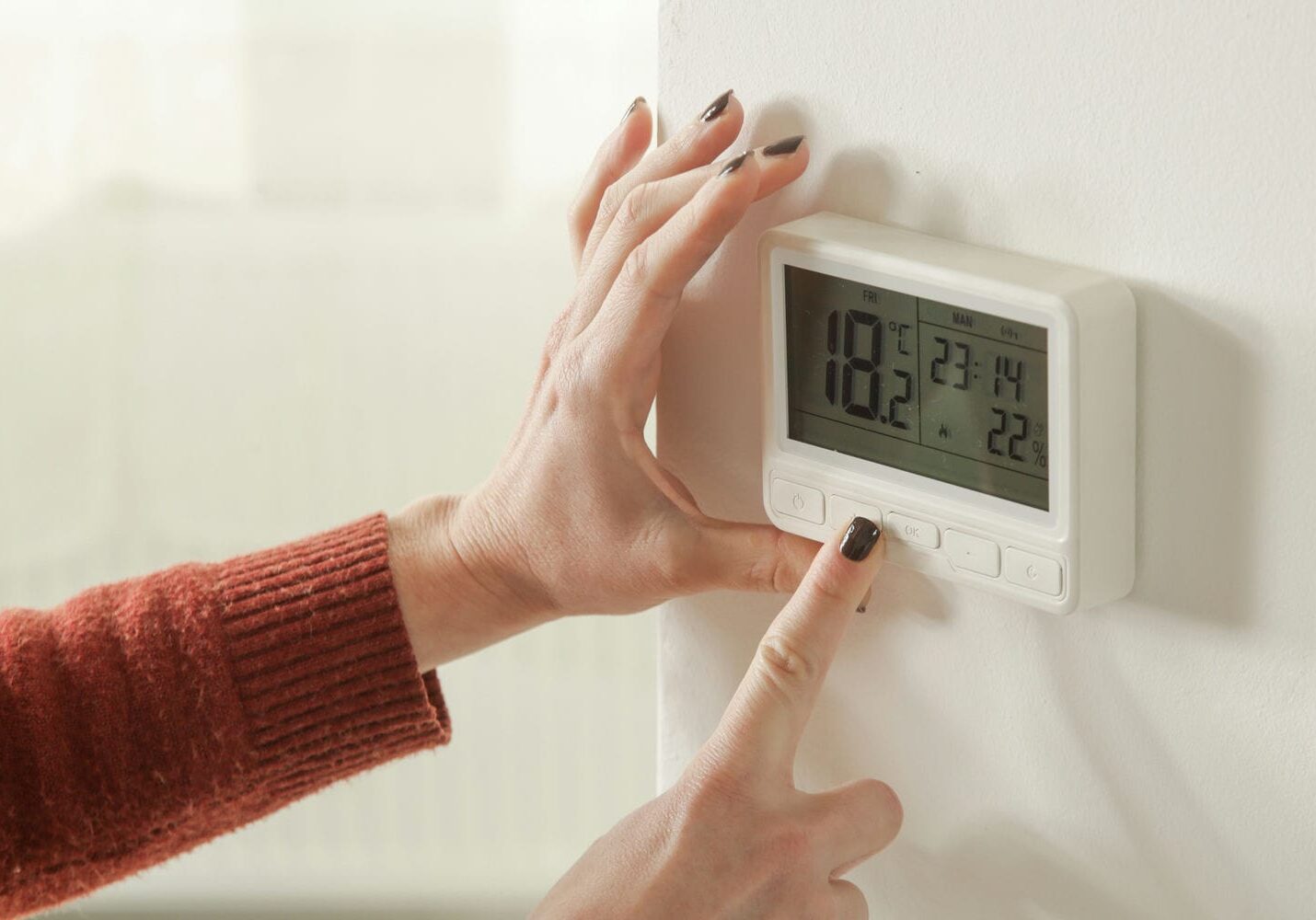
Start at the thermostat. Make sure the system is set to cool, not heat or fan only. Set the fan to auto, then lower the setpoint a few degrees below the current room temperature.
The fan setting matters. If the fan is set to on, the indoor blower can keep moving room-temperature air between cooling cycles. That can make the system feel like it is running but not cooling.
Give the system a few minutes to respond. If cool air returns, you may have caught a control issue, not a failed AC. If the air stays warm or the house still will not cool, continue with the filter, vents, breaker, and outdoor-unit checks.
Check The Air Filter
A dirty filter can restrict airflow enough to weaken cooling and strain the system. Natural Resources Canada’s guidance on central air conditioning explains that dirty filters, coils, and fans reduce airflow, lower capacity, and can lead to expensive compressor damage if ignored for too long.
If the filter is dirty, replace or clean it according to the filter type. Then let the system run and see whether cooling improves. If the system still struggles, the filter may have been part of the problem, but not the whole problem.
Check Supply Vents And Return Grilles
Closed vents and blocked return grilles can make a cooling problem worse. The AC may be producing some cool air, but the house will not cool properly if that air cannot move.
Open supply vents. Move furniture, rugs, curtains, or storage away from registers and return grilles. Keeping vents and registers clear matters because blocked airflow resists proper air movement through the system.
Do not start taking ductwork apart. Do not adjust blower components. If clearing vents does not help, the issue is likely beyond a simple homeowner fix.
Check The Breaker Once
A tripped breaker can stop the outdoor condenser while the indoor blower keeps running. That makes the system sound like it is on, even though it is not actually cooling.
Reset the AC breaker once if it has tripped. A single trip can happen during a storm, a power blip, or a moment of unusual load, and that kind of one-off fault is the only reason to flip the breaker yourself.
If the breaker trips again, stop. Do not keep resetting it. Repeated trips can point to electrical trouble, a failing part, or a system under stress.
Check Whether The Outdoor Unit Is Running
Stand near the outdoor unit and observe from a safe distance. Is the fan spinning? Is the unit silent? Is it buzzing? Is the indoor blower running while the outdoor unit does nothing?
A central AC needs the outdoor unit to reject heat. If the indoor blower is running but the outdoor unit is silent, the system may move air without cooling it. Common causes include refrigerant leaks, inadequate maintenance, electric control failure, sensor problems, and drainage problems, any of which can leave the outdoor unit silent or unable to start.
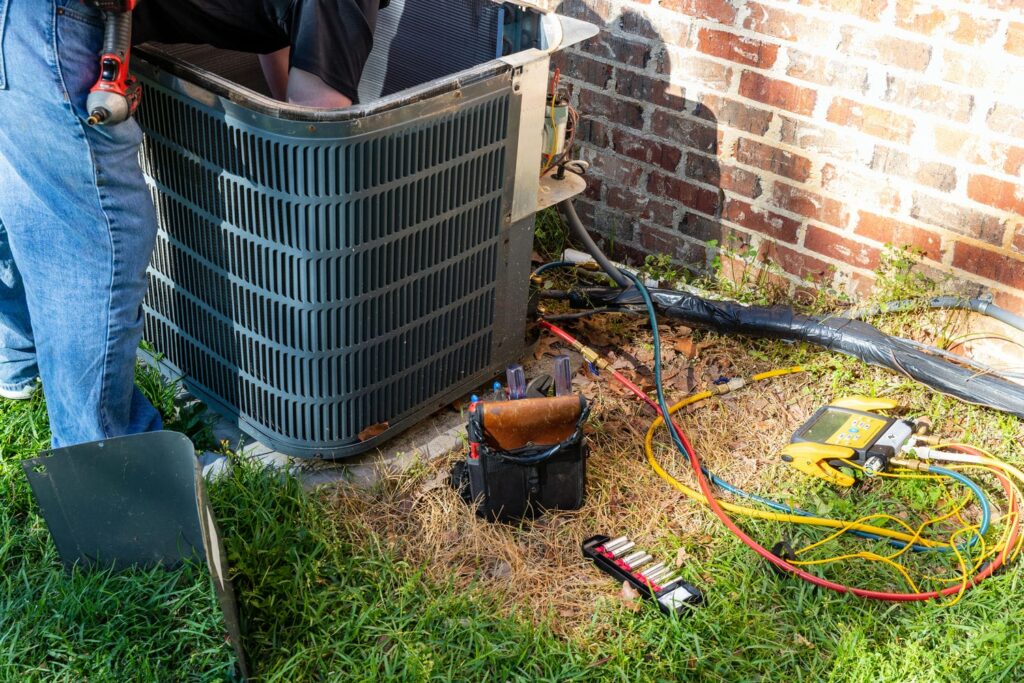
Do not test capacitors, contactors, motors, or wiring. You can observe the symptom. A technician should diagnose the cause.
Across all of these checks, leave the inside of the equipment alone. Refrigerant lines, capacitors, contactors, motors, internal panels, wiring, and pressure controls are technician work, not homeowner work. Stop entirely and book service if the breaker trips a second time, the outdoor unit buzzes but will not start, you smell something hot, see visible ice, find water around indoor equipment, or notice the system starting and stopping repeatedly.
When The Cause Is Not A Simple Setting
When the safe checks do not solve it, the cause is usually deeper. Frozen coils, low refrigerant, an undersized or aging system, or a specific symptom like warm air from the registers can all leave the AC running but not cooling, and each one needs a different response than a thermostat reset or a filter swap.
The Evaporator Coil Is Frozen
A frozen coil can block heat transfer and reduce airflow. The system may start with weak cooling, then get worse as ice builds. Eventually, it may run but barely cool the house.
Ice can come from restricted airflow, low refrigerant, dirty components, or other service issues. Dirty filters, coils, and fans reduce airflow and decrease system efficiency and capacity, all of which can push the coil toward freezing.
If you see ice on refrigerant lines, around the indoor coil area, or on outdoor equipment, turn cooling off and call for service. Do not scrape ice. Do not pour hot water on components. Do not keep lowering the thermostat.
The System May Be Low On Refrigerant
Refrigerant does not get used up like fuel. A central AC is designed to move refrigerant through a closed system. If refrigerant is low, it often means a leak, an incorrect charge, or a previous service issue.
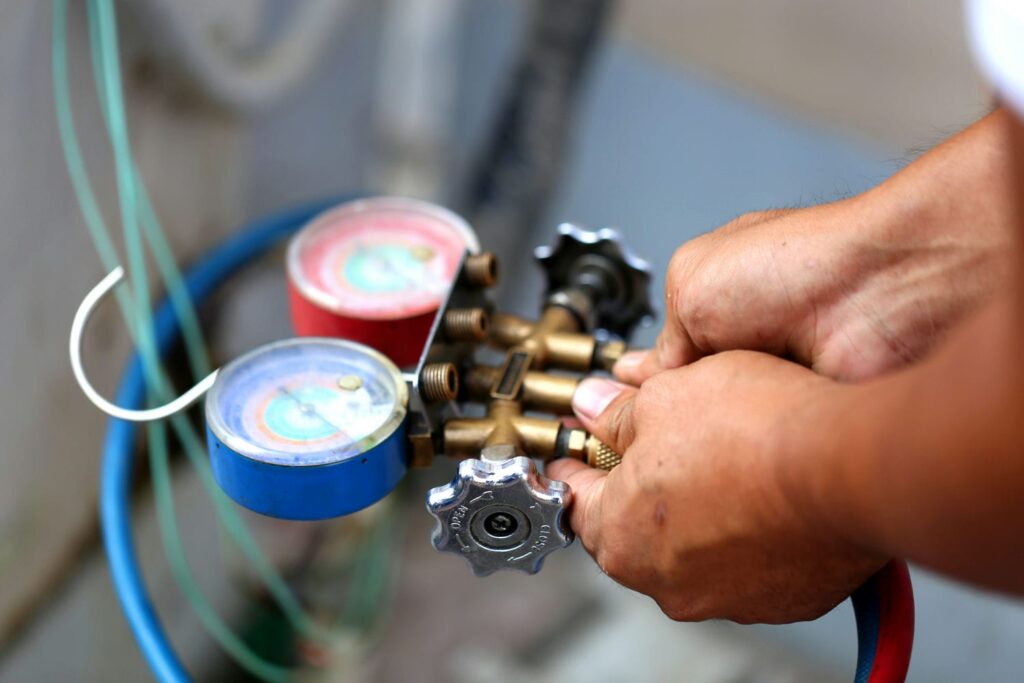
A trained technician should fix refrigerant leaks, test the repair, and charge the system correctly. A top-up without finding the cause is not a real repair.
If you notice ice, weak cooling, hissing, long run times, or repeated poor performance, the signs of an air conditioner refrigerant leak are worth recognizing before paying for any top-up that does not address the underlying cause.
Warm Air From The Vents Points To A Specific Symptom Set
“Not cooling” can mean several things. The house may cool slowly. One floor may stay warm. The vents may feel weak. Or the vents may blow room-temperature or warm air.
Warm air from AC vents is a more specific symptom. It can point to a thermostat setting, outdoor-unit failure, low refrigerant, frozen coil, or airflow restriction.
If the main symptom is warm air coming from the registers, you are likely dealing with an air conditioner blowing warm air, which follows a narrower troubleshooting path than a broad cooling check.
The AC Is Too Small, Poorly Matched, Or Nearing End Of Life
Sometimes the AC is running and nothing is “broken” in a simple way. It may be undersized, poorly matched to the home, fighting weak ductwork, or losing reliability with age.
An undersized unit may run constantly and still fail to satisfy the thermostat on hot days. An older unit may cool less consistently, run longer, and need more frequent repairs. A central air conditioner has a life expectancy of 15 years or longer, and replacement can make sense when problems become more expensive than they are worth fixing.
If poor cooling keeps returning on an older system, understanding the typical central air conditioner lifespan gives useful context for weighing another repair against starting a replacement plan.
Repair Or Replace: How To Think About The Bigger Decision
Do not jump from “not cooling” straight to replacement. Many cooling problems are repairable, especially when the system is newer or the fault is isolated.
That said, do not ignore the bigger pattern. A system that is old, unreliable, and no longer keeping the house comfortable may be telling you the repair conversation is changing.
Repair Usually Makes Sense For Simple, Isolated Problems
A simple fault on an otherwise healthy system is usually a repair conversation. That could mean a thermostat problem, dirty filter, minor electrical part, airflow obstruction, or maintenance-related issue.
This is especially true for newer and mid-life systems. If the AC has been reliable, cools well after service, and does not have repeated failures, repair often protects the value you already have.
The key is context. One fix on a stable system is different from another patch on a system that has been failing all summer.
Replacement Becomes More Likely When Poor Cooling Repeats
Replacement becomes more likely when poor cooling is paired with older age, rising bills, weak humidity control, frequent repairs, or major component failure. At that point, the question is not only whether the AC can be fixed.
The better question is what that repair buys you. If the answer is one more short stretch of weak comfort, replacement deserves a serious look.
This does not mean you should buy under pressure. It means you should compare repair value against remaining life before spending more money on a system that is already slipping.
If Replacement Is On The Table, Compare Fit Before Features
If replacement is likely, compare fit before features. A proper AC decision should consider sizing, matched indoor and outdoor components, airflow, install scope, warranty, comfort features, and efficiency.
Do not let a hot house push you into a rushed quote. The right system should fit the home, not just the budget line. It should also be installed in a way that protects performance.
If you are comparing new AC options and efficiency ratings, knowing what SEER2 means helps you use the rating in context rather than chasing one number blindly.
Get A Clear Diagnosis Before The Next Repair Or Replacement Decision
If your AC is still not cooling after you check the thermostat, filter, vents, breaker, and outdoor unit, the next smart step is a proper diagnosis. Guessing wastes time. Repeated resets, forced cooling, and DIY electrical or refrigerant work can make the problem worse.
We help Kitchener-Waterloo homeowners separate simple fixes from bigger cooling problems. Local Heating and Cooling has served homeowners for over 10 years, is an Authorized Lennox Dealer, and has offices in Kitchener and Waterloo.
If your AC is running but not cooling, reach out to Local Heating and Cooling for a clear service recommendation. If the system is older, unreliable, or no longer worth repairing, our air conditioner installation team can walk you through a properly sized replacement.
Frequently Asked Questions
The most common reasons are incorrect thermostat settings, a dirty filter, blocked vents, a tripped breaker, a non-running outdoor unit, a frozen coil, low refrigerant, or an aging system that can no longer keep up. Start with the safe checks first, and if the thermostat, filter, vents, breaker, and outdoor unit do not reveal a simple issue, book service.
Check the thermostat mode, fan setting, filter, supply vents, return grilles, breaker, and outdoor unit. Set the thermostat to cool and the fan to auto, replace a dirty filter, open vents, and reset a tripped breaker once. If the outdoor unit is silent, buzzing, or not spinning, stop and call for service.
Yes. A dirty filter can restrict airflow, reduce cooling, and contribute to freezing or system strain. Dirty filters, coils, and fans decrease efficiency and capacity and can lead to expensive compressor damage if left too long, so replace or clean the filter before assuming the system has a major failure.
The indoor blower can run even when the outdoor condenser is off, which means air moves through the house but the system may not be removing heat. A tripped breaker, failed component, control issue, motor problem, or safety shutdown can cause this, and if the outdoor unit is silent or buzzing while the indoor fan runs, book service.
Turn cooling off if you see ice, smell something hot, hear buzzing from the outdoor unit, or the breaker trips. You should also stop if the system keeps running without cooling after the basic checks, since running a struggling system can add strain and shutting it down at the right time can prevent a larger repair.
It can, but low refrigerant is not the only cause. Poor cooling can also come from restricted airflow, thermostat issues, a frozen coil, or an outdoor-unit problem, and if low refrigerant is involved, leaks should be fixed by a trained technician, the repair tested, and the system charged correctly.
Replacement becomes more likely when the system is older, repairs are frequent, comfort is poor, hydro use is rising, and the next repair would buy very little useful life. A single no-cooling problem does not automatically mean replacement, but a repeated pattern on an aging system deserves a broader repair-versus-replacement conversation.