
When a furnace fan won’t turn off, the cause is usually a thermostat setting or a timer finishing its job rather than a broken furnace. Two settings explain most of these calls: a fan switch left in the On position, and a circulation setting that runs the blower for part of every hour even while the switch reads Auto.
You have likely been listening to the blower for hours, or for days. The house is warm enough and nothing smells wrong, so what bothers you is the noise and the electricity.
Four things can hold a residential blower on, and telling them apart is the whole of a good furnace diagnosis. Two are settings you can change yourself, and two are repairs.
Checking those two settings takes a few minutes, and what happens afterwards tells you whether this is a setting to change, a timer to wait out, or a service call.
Why a Furnace Fan Won’t Turn Off: The Four Reasons a Blower Runs
A furnace does two jobs: it makes heat, and it moves air. Separate controls run each one, so a running blower is not proof the burners are lit.
- Something asked for the fan. The thermostat is calling for the blower on its own, with no call for heat.
- The furnace is finishing a heating cycle. The burners have stopped, and the control runs the fan to move the last of the heat into the house.
- The furnace is protecting itself. A safety control has closed the gas valve and turned the blower on to carry heat away from metal that got too hot.
- Something is holding the fan circuit closed. A relay, a damaged wire, or a control that failed with its blower output on will all do it.
They are also in order of how often they are the answer, so the first two cover most calls and the last two are repairs.
Two Situations That Call for Leaving the House
A blower that will not stop is not in itself a sign of a combustion problem, and most of this subject is settings. Two situations change that, and both are worth knowing before you go to the thermostat.
- A carbon monoxide alarm is sounding. Leave the house straight away and move to fresh air. Do not stop to look for the source, and call 9-1-1, the fire department or your local emergency service once you are outside. Preventing carbon monoxide exposure starts with getting out of the house, not with finding the cause.
- You can smell gas. The steps are different here. Leave the area immediately and do not use switches, phones or anything else that could spark. Call 9-1-1 or your local emergency number from a safe distance, do not go back inside until someone has inspected it, and do not relight anything.
A carbon monoxide alarm will not warn you about a natural gas leak, because the two are detected differently and many homeowners believe otherwise. Low concentrations of carbon monoxide start with a slight headache and shortness of breath during moderate activity, which are easy to mistake for something else.
The Four Checks to Make First: Settings, Heat, and Airflow
Four checks sort this out, and the first is the whole answer more often than people expect.
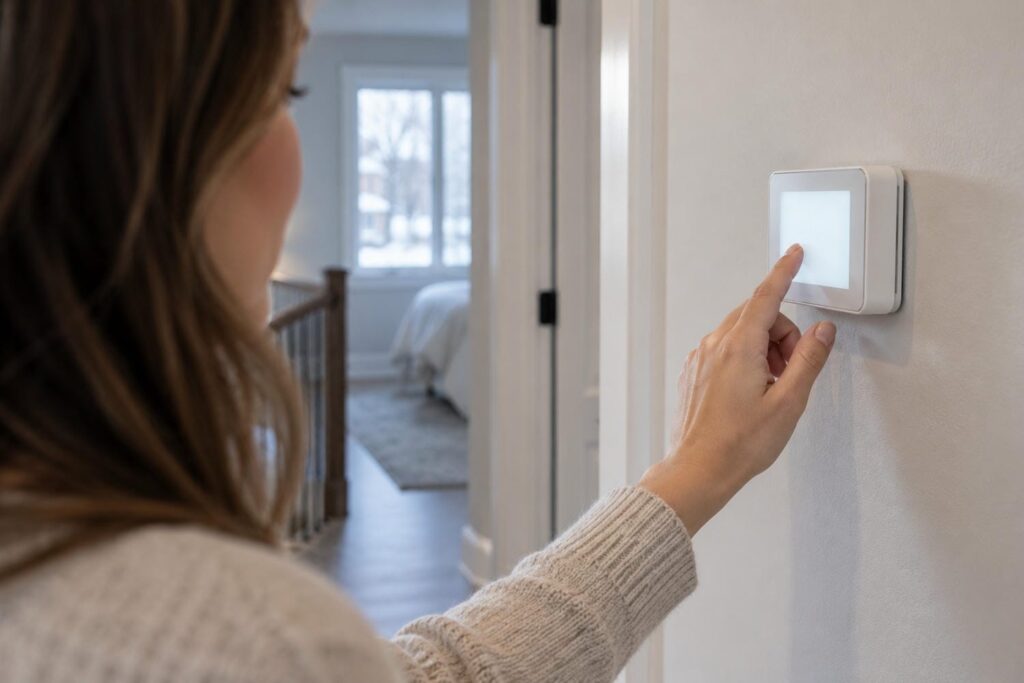
- Set the thermostat fan to Auto, then leave it alone for 3 minutes. In that position the blower runs only while the furnace is actually heating. The 3 minutes matter, because most modern furnaces hold the blower on for 60 to 180 seconds after the burners stop, and 90 seconds is the usual factory setting. That delay is set inside the furnace itself, so the figure in your own furnace’s manual is the one that applies to your house.
- Look for a circulation or minimum-runtime figure in the fan menu, and bring it down. A thermostat set this way runs the fan for part of every hour whether or not anything is heating, commonly about 20 minutes in every hour, which is why the blower never seems to stop while the switch still reads Auto. The exact number of minutes differs between thermostat families, so check the figure on your own thermostat rather than assuming 20.
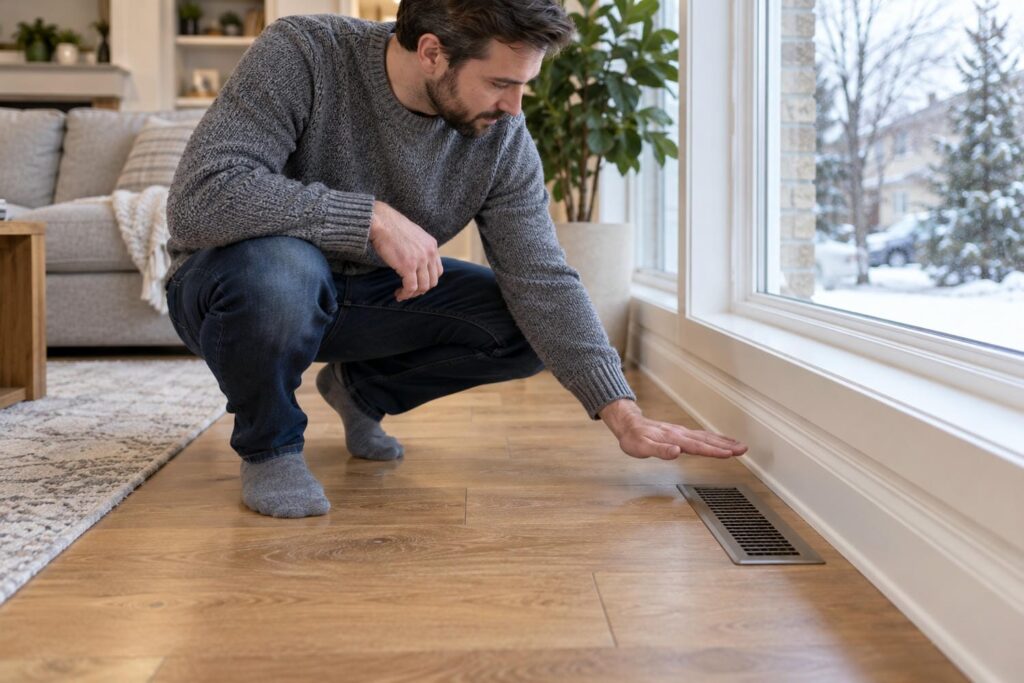
- Check whether the furnace is actually heating. If the air at the registers is warm, the fan is the only thing that will not stop. If there is no heat at all while the blower runs, the cause is a different one and it is more urgent.
- Clear anything that is restricting the air, which means loaded furnace filters, supply registers that have been closed off, and furniture sitting over a return grille. All three are things you can put right yourself in a few minutes.
If all four change nothing, the blower is being commanded from inside the furnace, and that is a service call rather than a setting.
Match What Your Blower Is Doing to the Usual Cause
The useful information you already own is the shape of what you are seeing. Whether the house is heating, whether the fan stops on its own, and whether anything you change at the thermostat makes a difference: those three observations separate the four causes better than any guess about which part has failed.
| What You Are Seeing | What It Usually Is | What to Do Next |
| The blower runs non-stop, the house heats normally, and the fan switch is set to On | The thermostat is holding the fan on, exactly as it was asked to | Set the fan switch to Auto and give it 3 minutes |
| The blower runs about 20 minutes in every hour and the switch says Auto | A circulation or minimum-runtime setting is turned on | Open the fan menu and bring the minutes-per-hour figure down |
| The blower keeps running for 1 to 3 minutes after the burners stop, then stops by itself | The fan-off delay is finishing the heating cycle | Nothing. This is the furnace clearing its own heat |
| The blower runs quietly and continuously at low speed on a variable-speed furnace | Continuous circulation, which is a selected operating mode | Decide whether you want it. A technician can change the setting |
| There is no heat, the burners are off, and the blower is running and not stopping | A safety control has opened, and the furnace is clearing heat it cannot get rid of fast enough | Book a service call. We find the restriction and clear it |
| Nothing you change at the thermostat makes any difference at all | The fan circuit is energized inside the furnace rather than by the thermostat | Book a service call. We test the fan circuit |
Two of these patterns look the same from the basement stairs, and they lead to different repairs. A furnace protecting itself from heat it cannot shed has a restriction behind it, and clearing that restriction is the work. A fan circuit energized with no call at all is an electrical fault inside the furnace.
Thermostat Settings That Run the Blower on Purpose
The thermostat does not run the blower itself. It closes a low-voltage circuit, and something inside the furnace runs the fan. On this side of the problem the request can come from three places, and all three are settings rather than faults.
The Thermostat Fan Switch Set to On
With the fan set to On, the blower runs continuously whether or not the heating or cooling is running. With it set to Auto, the fan runs only while the heating or cooling is running. The same switch does the same thing in July with the air conditioner running.
In that position nothing is broken: the furnace is doing what somebody asked it to do.
Most people move the switch to Auto, watch for 30 seconds, see no change, and decide the switch was not the cause. A fan-off delay and a circulation segment can easily outlast that much watching.
The Circulation Setting That Runs the Fan While the Switch Says Auto
A thermostat set this way does not run the fan in one continuous block. It splits the runtime into short segments and spreads them across the hour, so the blower comes back on several times an hour.
The setting is usually on because an installer turned it on, a previous owner turned it on, or a schedule on the thermostat runs the fan on its own.
The exact number of minutes differs between thermostat families, so the figure on your own thermostat is the one that applies.
Turning that figure down is a preference rather than a repair, because a furnace behaving this way is working exactly as somebody set it up.
Changing the Circulation Setting on a Nest, an ecobee, or a Honeywell Home Thermostat
Each brand names this setting differently.
- On a Nest, press the thermostat ring to open the Quick View menu, then choose Fan. You set a schedule under Settings, then Fan, then Schedule. A timed fan run switches itself off when the time expires, and a fan schedule cannot start or stop when you leave or come home.
- On an ecobee, the fan menu holds two things: the choice between On and Auto, and a figure for the minimum number of minutes the fan runs each hour. Set the fan to Auto and bring that minutes figure down, and the blower will stop between cycles instead of restarting part way through every hour.
- On a Honeywell Home thermostat, the fan switch or key has a Circ position alongside On and Auto, and Circ is the one that produces the 20-minutes-an-hour pattern.
Continuous Circulation on a Variable-Speed Furnace Is a Selected Mode
A quiet fan that never stops on a variable-speed or constant-torque furnace is very often the system doing exactly what somebody configured it to do.
On Lennox variable-capacity furnaces, continuous fan is a selectable mode that runs the blower at roughly a third of the speed the furnace uses for air conditioning, so it is turning slowly on purpose rather than struggling.
On a communicating system the airflow for that mode is a figure a dealer sets, adjustable across a wide range in small steps, and the right figure for a given house depends on the furnace and the coil it is matched to.
When continuous circulation is too loud or too expensive for you, the fix is usually a number in the installer menu rather than a part.
The Fan-Off Delay: Why the Blower Keeps Going After the Burners Stop
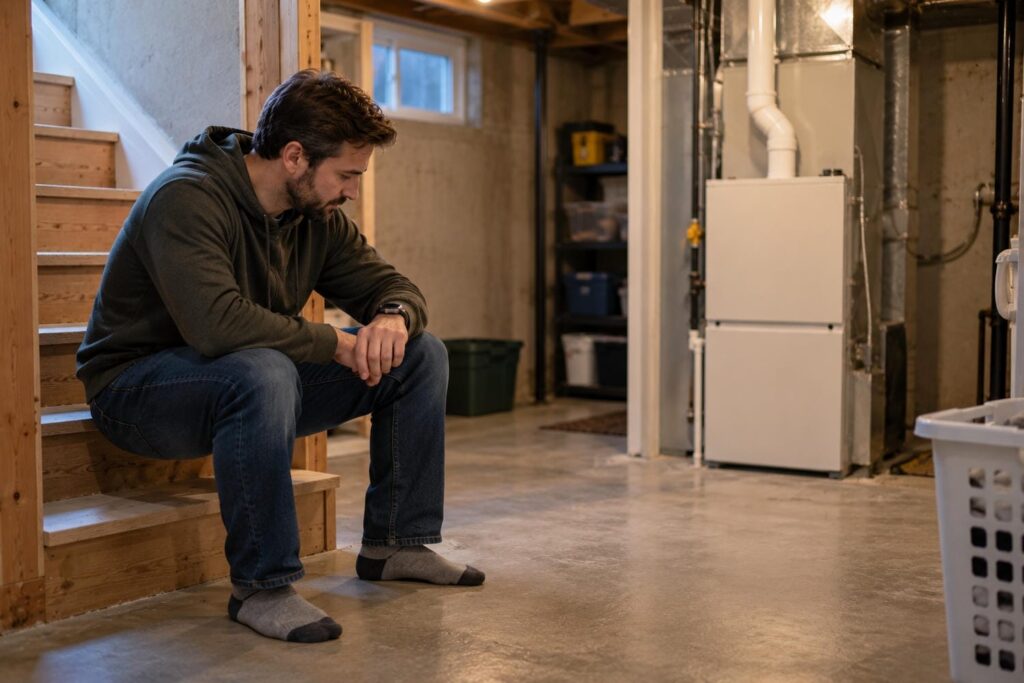
When the burners stop, the heat exchanger is still hot, and you have already paid for that heat. The control keeps the blower running to move it into the house. A homeowner watching a furnace that will not shut off is often watching a timer.
Why the Blower Starts Late and Stops Late
A furnace has a delay before the blower starts and a delay after the burners stop. Most homeowners have met one and not the other, and the two are set in completely different ways.
The delay before the blower starts is fixed by the manufacturer, and nobody can change it. On Lennox furnaces it is 30 seconds on one model family and 45 seconds on another, so which figure applies depends on the furnace in your basement. The delay after the burners stop is the adjustable one, and a technician sets it inside the furnace on the control board, sometimes with a switch and sometimes with a jumper.
That is why the fan seems to start late when the heat comes on and keeps going after it goes off, and neither of those is a fault.
Why a Technician Sometimes Sets a Longer Delay
The delay is not a default that somebody forgot to change. It is a number a technician chooses by measuring.
When we commission a furnace, we measure the supply air temperature at the exact moment the blower switches off, and we adjust the delay until that temperature lands inside the band the installation instructions call for. A longer off delay brings that temperature down. So a 3-minute delay can be a deliberate choice on your house rather than a fault.
On a communicating system the timing sits in the thermostat’s installer menu rather than on a switch inside the furnace, and a technician can read it and change it there.
The Furnace Is Protecting Itself: No Heat, Burners Off, Blower Running
The burners are off, no heat is coming out of the registers, and the blower is running and running. The fan is not stuck on, and the furnace turned it on deliberately. If what you have instead is air moving with no warmth in it, that is a different symptom: the blower runs but the rooms stay cold.
What the High-Limit Control Does When the Furnace Gets Too Hot
The high limit is a temperature switch that sits on the heat exchanger or in the supply plenum, and it opens when the furnace gets too hot.
When the limit opens, the furnace control does two things at once, and both are on purpose: it energizes the supply air blower and it de-energizes the gas valve. That produces exactly what you are looking at, which is no heat with the fan running. The fan keeps running because the metal is not cooling as fast as it should.
The limit resets itself once the temperature comes back to normal. The limit’s trip point is set at the factory and cannot be adjusted by anyone, including us.
The limit is not the broken part. It opened because something stopped the air, and the restriction is the fault.
Why the Heat Is Not Clearing Fast Enough
The furnace cannot shed that heat because something is restricting the air it needs to move. In the order we find them, the causes are a loaded filter, supply registers that have been closed off, furniture over a return grille, crushed flex duct, a blower wheel loaded with dust, and a motor losing speed.
Too much resistance in the ducts makes a furnace run hot enough to damage it. A motor working against a dirty filter or restrictive ductwork also draws more power, which is the link between the restriction and your bill.
If the furnace is starting and stopping repeatedly rather than running its blower without pause, that is short cycling, and it follows a different pattern.
When Nothing at the Thermostat Changes Anything
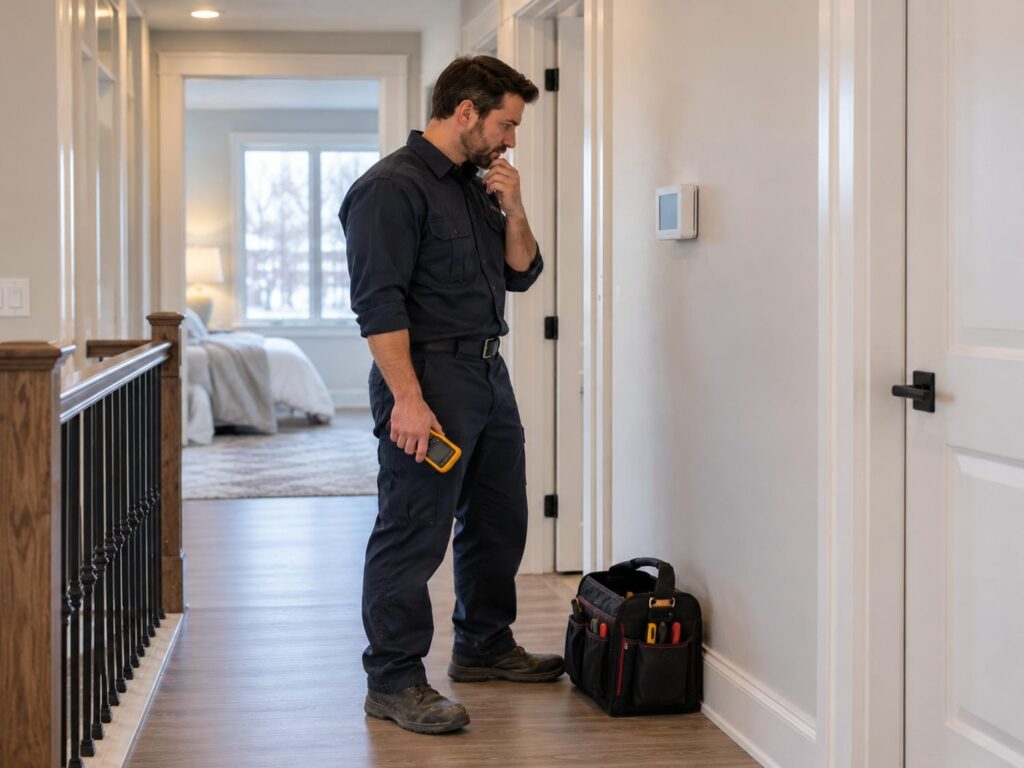
The signature of this last cause is that nothing you do at the thermostat makes any difference. You set the switch to Auto, take the circulation figure to zero, restart the thermostat, and the blower carries on exactly as before. That tells you something useful, because the request is not coming from the thermostat at all.
The Terminal Marked G and What It Does
The terminal marked G at your thermostat is the fan relay terminal. It does not drive the blower. It energizes a relay inside the furnace, and that relay runs the fan. The terminal marked R is the 24-volt supply.
It is also why some thermostats have no fan control at all: that only works where a fan wire sits at the G terminal.
A fan wire pinched or damaged inside the wall, or touching the power wire at the terminal block, can hold 24 volts on the fan relay permanently, and the thermostat cannot detect it. The current that runs a motor can weld a relay’s contacts together, so the circuit never opens again. A control board can also fail with its blower output on.
How We Rule Out the Thermostat, and Why This One Is a Service Call
We take the thermostat out of the picture by disconnecting the fan wire at the furnace control board. If the blower still runs with nothing connected to it, the fault is in the furnace control rather than in your thermostat or the wire in your wall. If it stops, we work back toward the thermostat.
In Ontario only a certified gas technician may open a gas appliance, so we run this test on a service call. Ontario sets who may work on a gas appliance, not the contractor.
Replacing the thermostat fixes the cases where the thermostat was the cause and leaves a damaged fan wire or a welded relay exactly where they were, so we rule the thermostat out before anyone buys a part.
What Running the Fan Continuously Costs, and Whether It Is Worth It
Most people assume a running fan is free because the burners are off. It is not free, and it is the one number in this subject you can act on directly.
About $10 a Month, and How We Work That Figure Out
Running the blower around the clock costs about $10 a month, or roughly $8 to $13 depending on the furnace and the ductwork.
The arithmetic is short enough to redo for your own furnace. A mid-size furnace blower on its lowest speed draws about 127 watts. Running all day, that is about 3 kWh, which comes to about 91 kWh over a 30-day month. At Ontario’s regulated price of 11.2 cents a kWh, that month costs $10.24.
The 127 watts is the manufacturer’s bench figure for one mid-size furnace at its lowest speed with no filter fitted, so a real house with a filter and real ductwork sits toward the top of the $8 to $13 range. The $10 is the electricity for the fan alone, at the regulated price for the first 1,000 kWh a month from 1 November 2026, before delivery and regulatory charges and before the Ontario Electricity Rebate. Your electricity distributor, Enova Power, bills that price but does not set it. The provincial regulator sets it and changes it on 1 May and 1 November each year.
What You Get for the Money, and What Else It Costs
Running the fan continuously does even out temperatures between rooms, and on a variable-speed furnace it does that quietly and at low speed. Whether that is worth about $10 a month is your call rather than ours.
The motor in most newer furnaces holds close to 80% efficiency even when it is turned down, while the older style runs at 60% to 65% at its best and gets less efficient the slower it turns. On an older single-speed blower, the same request costs more and gains less.
A blower running every hour of every day accumulates roughly three times the running hours of one that runs only with the heating, and bearings wear by the hour. The electricity is the part we can put a number on, and the wear shows up later, as noise.
What a Proper Diagnosis Measures
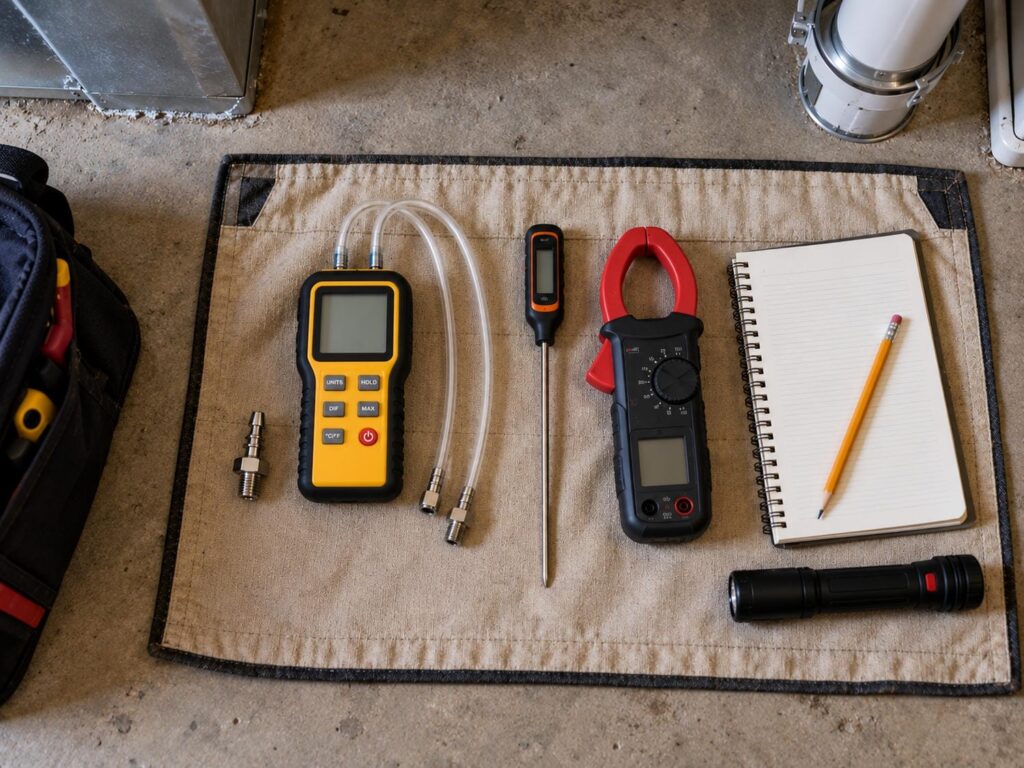
Once you have checked the settings, the question is not which part looks suspicious. It is what the furnace is doing, in numbers.
- We measure the supply air temperature at the exact moment the blower switches off, which tells us whether the delay suits this house.
- The temperature rise across the furnace gets compared against the range on its rating plate, and we read that as whether the furnace is moving enough air.
- On a manometer we read the total external static pressure against the limit the equipment was designed for, which shows how hard the blower is working.
- Last, we check the current draw on the blower motor, which tells us whether the motor is still doing its job.
On a communicating system the furnace reports restricted airflow itself and names the filter and the ductwork as what to check, and we read that on site. An older furnace has no code to read, so temperature rise and static pressure give us the same answer.
Whoever opens your furnace should hold a current TSSA certificate and work for a registered contractor, and you can check both before they arrive.
The Annual Inspection, and What It Settles About the Blower
Have every fuel-burning appliance in your house inspected once a year, which is the interval your gas utility asks for. On this symptom, that visit settles three things.
- We check the fan-off delay and the temperature rise against what the furnace is rated for.
- We set the continuous-fan setting to what you actually want rather than leaving it where it was.
- We confirm the return grilles and supply registers are clear.
Annual furnace maintenance is also where we notice a blower that is starting to wear, before it turns into a repair.
Book a Diagnosis for a Blower That Will Not Stop
The readings that settle this symptom are not ones a homeowner can take: supply air temperature at the moment the blower switches off, temperature rise against the rating plate, total external static pressure on a manometer, and current draw on the motor. Those four separate a furnace working as it was set up from restricted airflow tripping the limit, and from a fan circuit energized inside the furnace.
Local Heating and Cooling has worked on furnaces in the Kitchener-Waterloo area for over 10 years, from offices in Kitchener and Waterloo. We are an Authorized Lennox Dealer, and that matters on this symptom: the delay settings and limit behaviour on this equipment come out of manuals we work from every week. A furnace repair visit for this symptom starts with those four readings rather than with a parts list.
Check the two settings first. If the blower carries on regardless, book a visit with our team.
Frequently Asked Questions
A circulation or minimum-runtime setting is turned on. The fan switch still reads Auto while the thermostat runs the blower for part of every hour, commonly about 20 minutes in each hour, which is what people describe as a fan that never stops. Open the fan menu and bring the minutes figure down, and the blower will stop between heating cycles.
Between 60 and 180 seconds on most modern furnaces, and 90 seconds is the usual factory setting. The delay is set inside the furnace, so the figure in your own manual is the one that applies to your house. Give it 3 minutes before you decide anything is wrong, because 30 seconds of watching is not long enough to tell you anything.
It is a choice rather than a fault. Continuous circulation evens out temperatures between rooms, and on a variable-speed furnace it runs quietly at low speed because that is what the mode was designed for. It costs about $10 a month, and the extra running hours do add wear. On an older single-speed motor the same choice costs more.
Usually not. The blower running is not a sign of a combustion problem, and most of the time the cause is a setting. Two things change that answer. If a carbon monoxide alarm sounds, leave the house and call 9-1-1 or your local emergency service from outside. If you smell gas, leave the area without touching switches or phones, and call from a safe distance.
About $10 a month for most furnaces, and roughly $8 to $13 depending on the furnace and the ductwork. That is the electricity for the fan alone at Ontario’s regulated price, before delivery and regulatory charges. A mid-size blower on low speed draws about 127 watts, so you can redo the arithmetic for your own furnace from its own wattage.
We would not. Cutting the power stops the heat as well as the fan, and if a safety control has opened, the blower is the only thing carrying heat away from the furnace. Switching it off is the one move that makes that situation worse. Set the fan to Auto, wait out the delay, and book the visit if the blower keeps running.
Sometimes. A new thermostat fixes the cases where the thermostat was the cause, and it leaves a damaged fan wire or a stuck relay exactly where they were. That is why we rule the thermostat out by testing before anyone buys a part. We would rather find the fault than replace a part that may be working.