
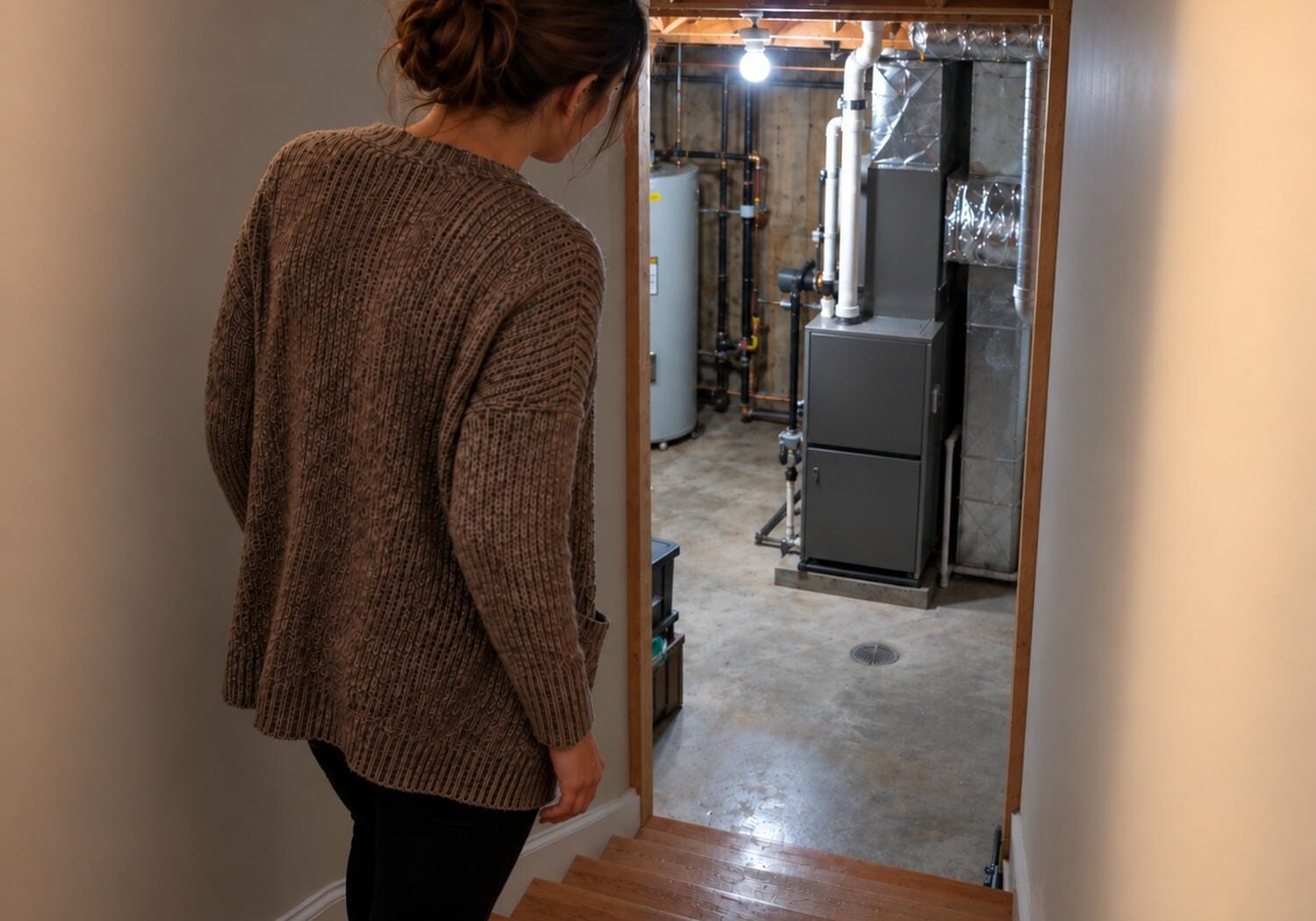
A furnace squealing noise comes from one of three things: the bearings inside the blower motor, a belt on an older furnace, or the small fan that clears the combustion gases. The bearings are the usual answer by a wide margin, and we find the belt and the small fan far less often. How the noise sounds will not tell them apart, because all three arrive high and sharp through a floor register. What separates them is when in the heating cycle the noise happens, and you can hear that from the hallway without opening anything. Pinning down which part it is comes before anything else, and that is what a furnace diagnosis is for. So this page gives you the listening test, a straight answer on oiling, what not to do in the meantime, and how long it can be left.
What a Furnace Squealing Noise Actually Means
A squeal is a rubbing noise, and it always comes from something that is turning. Two surfaces that should be held apart by a film of oil, a film of grease, or a belt gripping a pulley are touching each other instead. That is the whole mechanism, and it is why the noise is so sharp.
That matters, because a furnace has only three assemblies that turn fast enough to squeal: the indoor blower that pushes warm air into the ducts, the small fan that pulls the combustion gases out through the vent, and, on an older furnace, a belt running between two pulleys. Everything else inside the cabinet either sits still or moves slowly. A squeal needs steady rubbing at speed, and a part that barely moves cannot supply it.
So the list of possible causes is short, and the real work is in telling three things apart. You are not hunting through a whole appliance. You are choosing between three places to look, and the choice is made by listening.
When to Shut It Off, and the Two Real Emergencies

Most squeals are something you book, not an emergency. One rule covers a noise that arrives suddenly: if a normally quiet furnace starts making a loud noise, shut the system off and call for repair. There are two places to do that, the thermostat and the switch on the side of the furnace.
Two situations are different. If you smell gas, get everyone outside first, then call 911 from outside the house. Your gas utility also keeps a 24-hour emergency line, and which one that is depends on where you live: Kitchener has its own gas utility, and much of the surrounding area is on Enbridge. Do not hunt for the leak, and do not touch switches on your way out.
If a carbon monoxide alarm sounds, Ontario’s instruction is to get everyone out immediately and call 911 from outside the building. Ontario’s Fire Code requires an alarm next to each sleeping area and on every storey, in homes with a fuel-burning appliance, a fireplace or an attached garage. A squeal is a mechanical noise and not a sign of carbon monoxide, but an alarm on every storey covers what you cannot hear.
How to Tell Which Part Is Squealing: Listen to the Cycle
How it sounds will not separate these causes. All three arrive high and sharp through a floor register. The ducts change the sound on the way, so the loudest room is rarely the right one. Timing separates them. Stand where you can hear the furnace, raise the thermostat, and note whether the noise leads the cycle or arrives just after the burners light.
Noise That Starts Before Any Air Moves
The small fan that clears the combustion gases runs first on every call for heat. It starts before the burners light and before any warm air reaches a vent. So a noise that leads the cycle is pointing away from the indoor blower. That piece of timing does more work than any description of the sound.
Trane’s troubleshooting guidance names the inducer motor among the causes of a high-pitched sound from a furnace, and that is the part doing the leading. Its sound is usually thinner and higher than the blower’s, because it is a smaller wheel turning faster. Identify it by when it runs, and leave it there.
Noise That Arrives 30 to 60 Seconds After the Burners Light
Most furnaces hold the blower back for 30 to 60 seconds after the burners ignite, so the heat exchanger warms before air moves. That delay is a gift when you are listening. A squeal that arrives in that window and runs for the rest of the cycle belongs to the indoor blower.
Manufacturers put it plainly: grinding or squealing from a blower usually points to worn bearings or something loose. Both of those sit behind the blower door, which is where this branch ends. If what you noticed in that window was cool air at the start of a cycle rather than a noise, that is a different question.
The Fan-Only Test You Can Run From the Thermostat
Set the thermostat fan to ON and turn the heat down so the burners will not fire. Give it a few minutes, not 10 seconds, and listen from the same spot you listened from before. If the noise is there, it is on the blower side. If it disappears, it belongs to something that only runs on a call for heat.
Then set the fan back to AUTO. This is the test we run first when we arrive, and it costs you nothing to run it yourself. If the blower does not come on at all in that mode, that is a different problem and worth a call.
A Squeal Is Not a Whistle
A metallic squeal or screech is rubbing. A whistle, a moan or a rush of air is air being pulled through a restriction. The two get confused because both arrive high-pitched at a floor register. A dirty or too-restrictive filter is one of the sources manufacturers name for a high-pitched sound.
So fit a fresh filter before you book anything. A filter is a few minutes and no tools, which makes it the right first move. If the sound changes, you were listening to airflow rather than metal on metal. In that case the right filter for your furnace is where to start, not the motor.
A squeal that seems to fit more than one of these is still worth a call, because sorting the overlap is what a technician does standing at the furnace.
| What you hear | When it happens in the cycle | Most likely source | What to do |
| A high squeal or screech that runs for the whole heating cycle | Starts 30 to 60 seconds after the burners light, and is also there with the fan set to run on its own | The bearings in the indoor blower motor | Book a technician. Shut it off at the thermostat or the furnace switch if the noise turns sudden or loud. |
| A squeal that is loudest at start-up and eases as the blower comes up to speed | At the start of every cycle, on an older furnace where the motor sits beside the blower | A worn, loose or misaligned belt | Book it. Belt tension and alignment are a technician’s adjustment, not a job for a spray can. |
| A thinner, higher sound | Present before the burners light and before any air moves | The small fan that clears the combustion gases | Book it. Do not open the furnace to look for it. |
| A whistle, moan or rush of air rather than a metallic squeal | Whenever air is moving, and it changes when the filter is fresh | Air through a restriction, not a mechanical fault | Fit a fresh filter first. If that changes the sound, start there rather than with the motor. |
| A sound that gets louder and quieter as the cycle runs | Through the whole cycle, on a variable-speed furnace | The motor changing speed, which it is built to do | Judge the character and the trend, not the change in volume. Book it if it is a squeal, or if it is getting worse. |
How a Blower Bearing Starts to Squeal
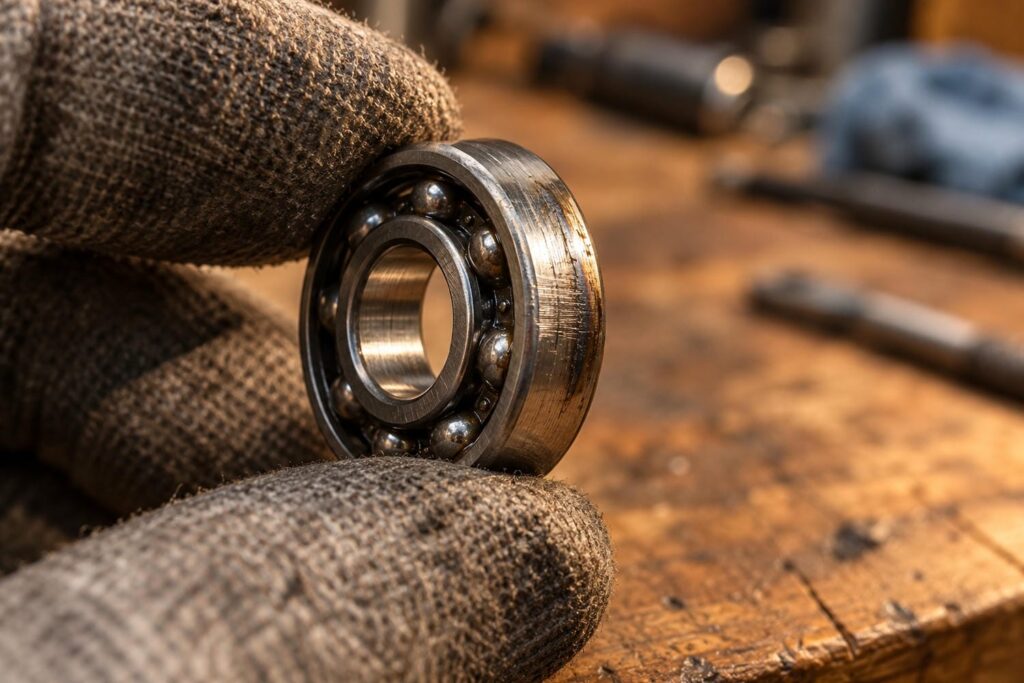
A bearing is the thing a motor shaft spins inside. Of everything in a furnace that can squeal, the blower motor’s bearings are the one we find most often, and by a wide margin. A bearing starts making noise for a reason, and it can come and go for weeks before it settles in.
Why a Dry Bearing Squeals
A motor shaft is meant to ride on a film of oil or grease. When that film is gone, metal touches metal at well over a thousand turns a minute, and the stick and slip of that contact is the noise you hear. It is a known chain: bearings wear, and the blower stops running quietly. Lubrication sits at the top of the bearing industry’s own list of why bearings fail.
Two designs matter. A plain sleeve bearing depends entirely on an oil film. Sealed ball bearings are packed with grease and closed up at the factory. That difference decides whether there is anything you can do about it.
Why It Sometimes Only Squeals on the First Start of the Day
A bearing with a marginal film is at its worst cold and at rest. So the first cycle of the morning squeals and the ones after it do not, and the sound seems to fix itself by mid-morning. A squeal that comes and goes with the outdoor temperature is telling the same story.
An intermittent squeal is an early squeal, not a harmless one. It is the stage where the part is still a part and the repair is still small. Write down when it happens, because that is the first thing we ask.
Is There Even a Belt?
A belt is only in the running on an older furnace, where the motor sits beside the blower and drives it through a belt and two pulleys. On newer furnaces the blower wheel is mounted straight onto the motor shaft, so there is no belt to squeal. Look for a rubber belt through the sight glass or the louvres. If there is not one, cross it off and move on.
Where there is a belt, Carrier’s guidance is to check it on older belt-driven units for wear or looseness. Tension and alignment are a hands-on adjustment that a direct-drive machine never needs, which is the practical difference between the two designs. A belt wears as a matter of course, and it is meant to.
A slipping belt is working hardest at start-up, so a belt squeal usually peaks when the blower kicks in and then eases. Belt dressing or a penetrating spray on a slipping belt buys a few days and glazes the pulley, which makes the slip worse once it wears off. Leave the can on the shelf.
Should You Oil the Blower Motor?
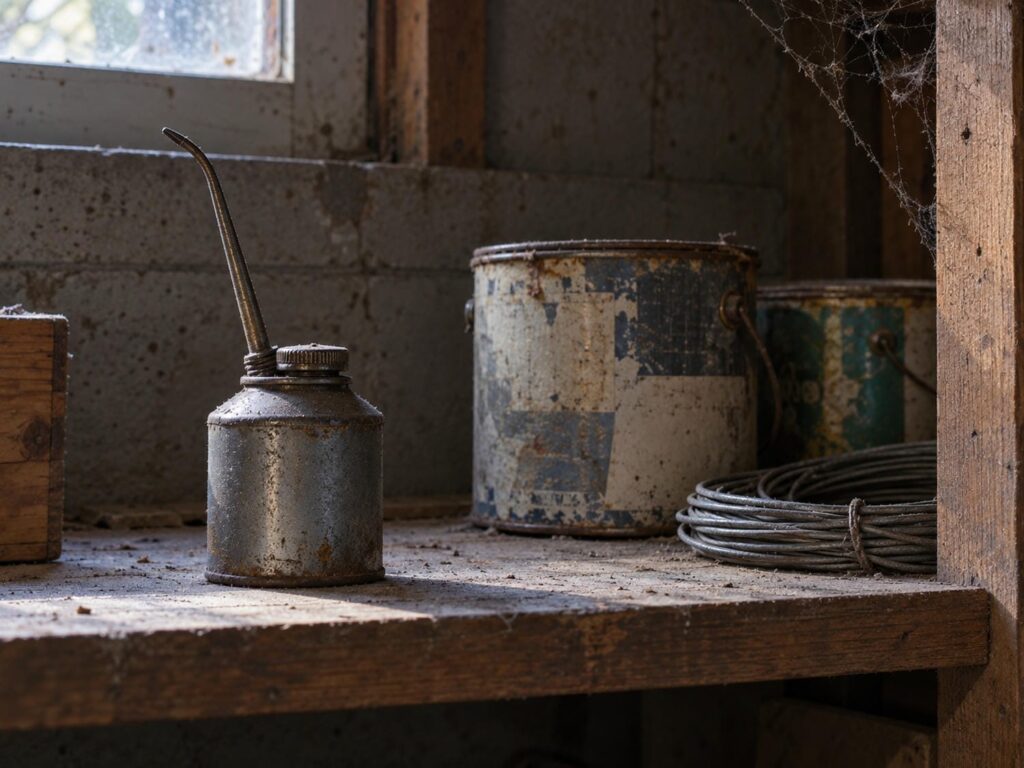
The advice you will find everywhere is to oil it, and it is the thing most likely to finish the part off. You can settle whether there is anywhere to put oil by looking at the motor, not by its age. That is a minute of looking, and it answers the question for your furnace.
Look for an Oil Port
Look at the motor for a small port or a plug near each end of the shaft. If there is no port, the bearings were greased at the factory and sealed, and there is nowhere for oil to go. US MOTORS, a motor manufacturer, describes sealed bearings as lubricated for life. That is the design rather than a shortcut: they were never meant to be opened.
Forcing oil past a seal pushes dirt in and grease out. The motor gets quieter for a week and then louder than it was. If you cannot find a port, you have your answer, and there is nothing here for you to do.
If There Is a Port
If the motor does have oil ports, what goes in them is set by that motor and not by a rule of thumb. The maker’s own documentation fixes the grease and the interval, based on the motor’s speed, its bearing type and the work it does. Those vary from motor to motor, so a number copied off a forum is the wrong number.
There is a second reason to leave it. A furnace old enough to have oil ports has a bearing old enough that someone should be looking at it rather than topping it up. The short version is to leave the oiling alone.
What Not to Do While It Is Squealing
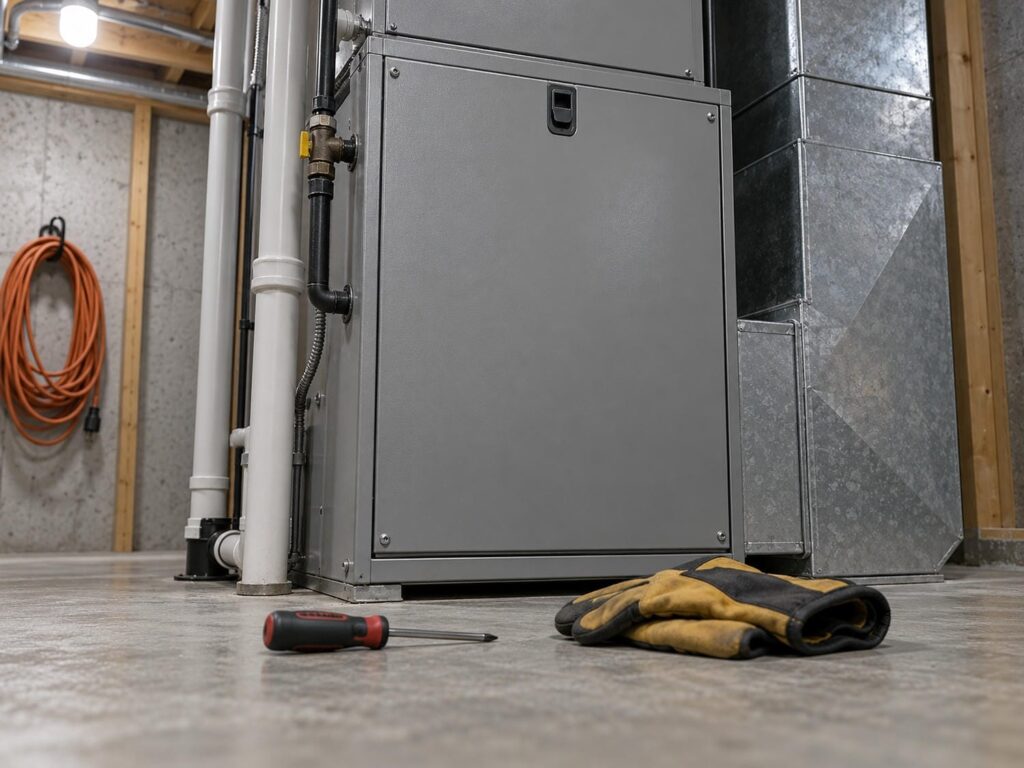
The squeal is the audible stage of a mechanical failure, so between now and the service call the goal is not to quieten it. It is to avoid making it worse. Leave the blower door shut.
Carrier is blunt about the blower compartment: repairing or replacing a blower motor is complex work involving high-voltage wiring, and it is best left to a professional. Attempts at the capacitor or the wiring can be unsafe, and they can void a warranty or damage other parts. A warranty claim on a blower motor is worth more than a weekend of tinkering.
There is a physical side as well. The blower wheel is heavy and keeps turning after the power is cut. The interlock on that door exists for reasons that have nothing to do with noise.
How Long Can You Leave It?
Not indefinitely. A squealing bearing does not settle down, and the way it ends is a blower that stops on a cold night. So the useful question is not whether to book it but when, and the answer is in what the bearing does next.
What Happens to a Dry Bearing Next
A squeal getting worse week over week is a lubricant film that has gone, and that runs one way. It does not reverse on its own. If you are getting less heat as well as the noise, treat that as two reasons to book rather than one. A furnace that turns on and then shuts off is a separate question.
Bearing makers’ failure guidance describes where that ends. A bearing that overheats while it is turning discolours, and the hardened parts then soften and deform as damage builds. In plain terms, the part stops being a bearing and becomes a seized lump on a shaft, and the blower stops with it.
The Signs That Mean Book It Today
Four things move this up the list. The noise arrived suddenly, or it is getting worse. You smell burning, or you see any sign of electrical trouble. The noise is there when the furnace is not running. The furnace is 15 years or older and has not had a professional service in over a year.
These are our booking criteria, and matching any one of them is enough. You do not need two. A squeal plus one of these is the difference between a visit this week and a visit when it suits you. Say which one applies when you call.
A Change in Volume Is Not a Squeal
A variable-speed blower starts low and changes speed while it runs, so how loud it is will rise and fall through a cycle. Older blowers ran at only a few fixed speeds, so their noise was steady: either there or not. A squeal is a different thing from a change in volume.
Manufacturers specify variable-speed motors for quiet running. They also describe what a healthy furnace sounds like: a soft hum when the blower starts, a gentle click at ignition, and a brief whoosh as warm air reaches the vents. A screech is not on that list.
So the question to ask about a quieter, newer furnace is not whether the sound varies. It is whether what you are hearing is a squeal, and whether it is worse than it was last month. Both of those you can judge from the hallway.
What Is Yours to Touch, and Who Does the Rest
Your own jobs on a gas furnace are the filter, the thermostat and the switch on the side. Everything behind the blower door is gas and high voltage, and that is not homeowner territory. The line is not about skill. It is about what sits behind the panel and what happens when it is disturbed.
In Ontario, TSSA-registered contractors are the only businesses legally allowed to do fuels work, and the person who should be at your furnace is a certified gas technician working for one of them. What matters is that the certificate is current and the contractor is registered. You can check a contractor against TSSA’s public registry before you book.
That boundary is also the reason the fan test and the filter check are both safe to run yourself. Neither one needs a tool. Between them they narrow the answer a long way before anyone arrives.
What the Repair Depends On
What it costs comes down to three things: which part is making the noise, whether the motor is a standard one or a variable-speed unit, and how old the furnace is. A variable-speed motor and its control sometimes have to be dealt with as a pair, which is a bigger job than a standard motor. The small fan and the blower are different parts, and they do not price alike.
Age changes the arithmetic too. At some point the sensible money goes toward the next furnace rather than this one’s blower, and that is a conversation rather than a rule. It is also the one factor you already know before anyone arrives.
The biggest lever is timing. A bearing caught while it is still only noisy is a smaller job than a seized motor on the coldest night of the year. That is the main reason not to wait. We quote it after we have heard the furnace run.
What an Annual Service Checks on the Blower

A service visit is when someone puts hands on this bearing. HRAI, the Canadian HVACR trade association, lists cleaning the motor and fan and checking the blower’s operation among the items in an annual heating service, along with checking a fan belt’s condition, tension and alignment on older systems. HRAI also says a proper cleaning and tune-up should be done by a licensed technician. The timing matters as much as the visit. Ontario’s own advice is to have fuel-burning appliances cleaned and inspected every year before the cold weather sets in, not during it.
A bearing that is audibly dry in January was usually measurably tight in October. Fall is when that gets caught while it is still an adjustment. So annual furnace maintenance is worth booking before the heating season.
Have Someone Listen to It Before It Stops Blowing
You now know roughly where the noise lives. The next step is someone standing in front of the furnace while it runs a full cycle, listening to the start, the burner light and the blower hand-off. That is the part you cannot do from the hallway, and it is what a furnace repair visit is for.
We have been working on furnaces across the Kitchener-Waterloo area for over 10 years. We have offices in Kitchener and Waterloo, so the drive is short. We are also an Authorized Lennox Dealer.
Book a visit and we will listen to it run before we tell you what it needs. Bring us the timing you collected, and the call starts further along than it otherwise would. If the noise has already turned sudden or loud, shut it off at the thermostat first and then call.
Frequently Asked Questions
Because it is the same blower. In a forced-air house one blower moves the air for heating and for cooling, so a noise that turns up in July and again in January is pointing at the part the two seasons share. That narrows the answer rather than widening it. A year-round noise is a blower-side noise, and that is worth saying when you book.
Probably not. A squeal that comes and goes is the early version of the same problem, and a quiet spell is not a repair. The useful thing is that you caught it while the furnace still runs, which is a cheaper position than the one you are in when it stops. Have it looked at before the next cold snap, while it is still a bearing rather than a seized motor.
If the noise arrived suddenly or it is loud, shut it off and book the call. If it is a steady squeal and the house needs heat, running it until the technician arrives is a judgement call. The things that change that judgement are a burning smell or any sign of electrical trouble. If either of those shows up, shut it off at the thermostat or the switch on the side and leave it off.
Four things, and they often decide what goes on the van. When in the cycle the noise happens. How long it has been going on. Whether it is getting worse. Whether it is still there with the fan set to run on its own and no heat called. None of those takes a tool, and together they tell us which part to expect before the van leaves the shop.
Usually not, because the noise is coming from one rotating part. What a technician checks at the furnace is whether the bearing can be served at all, whether the wheel and shaft still run true, and whether a variable-speed motor and its control have to be replaced together. Those answers, with the age of the furnace, are what settle it. Until someone has the panel off and the furnace running, anything else is a guess.
Usually, yes. The ducts carry the sound away from the furnace and change it on the way, so the room where it is loudest is rarely the room with the part in it. A metal duct is a good conductor of a squeal and a poor map of where it started. That is exactly why how it sounds is a poor guide and when it happens is a good one.
Yes. A bearing can fail early, and age is not a guarantee of anything. On a newer furnace the parts warranty is the reason to report it rather than touch it, because work in the blower compartment can void that cover. Call it in while the noise is still the only symptom, and let the warranty do the work it was sold to do.