
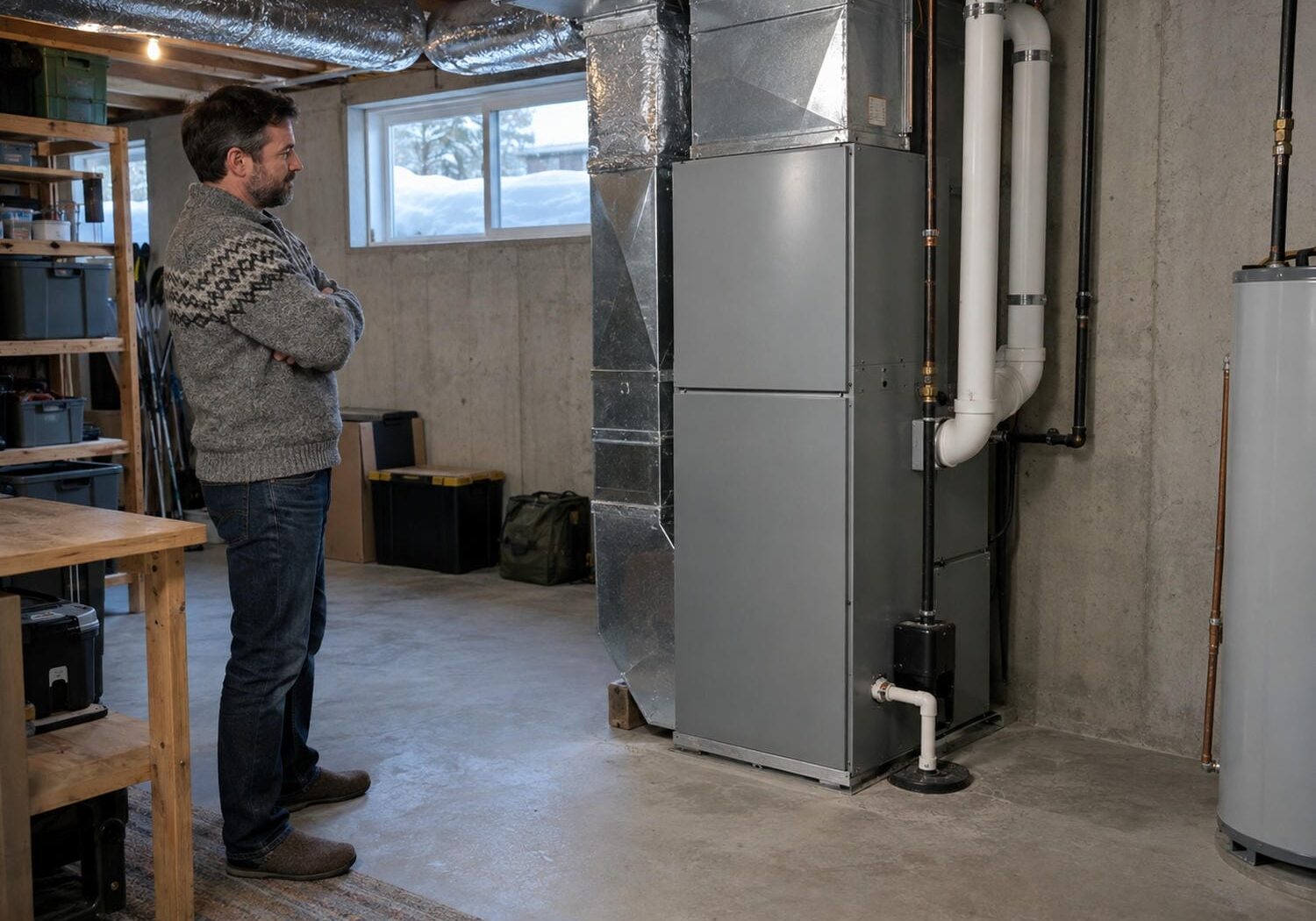
When a furnace works intermittently, the cause is almost never random. Something in the system is sitting right at its limit, and a control board is quietly stopping and restarting itself around it. You know the pattern. Fine on Tuesday. Dead on Thursday night. Running again Friday morning, and nobody touched a thing.
You are not imagining it, and your furnace is not temperamental. It is a diagnosis problem before it is a repair problem: a good furnace diagnosis starts with what the failure pattern tells you, not with the part that usually breaks.
So here is what makes a fault intermittent, why the furnace looks like it healed itself overnight, the one thing not to do before we arrive, and how we find a fault that is not happening.
What It Means When a Furnace Works Intermittently
A furnace is a chain of conditions that all have to be true before gas is allowed to burn. The thermostat calls. The board has power. The inducer pulls enough draft to close a pressure switch. The ignitor heats, the gas valve opens, and the flame proves itself within seconds. Then the heat has to leave the heat exchanger fast enough that nothing overheats. An intermittent fault is one link in that chain passing some days and failing others.
Marginal Is a Real State, Not a Maybe
Every link in that chain is a threshold, not a switch. A hard failure is a link that is broken all the time. A marginal one sits close to its threshold, so whether it passes depends on conditions outside the furnace: how cold the night is, which way the wind blows, how loaded the filter has become, whether ice formed overnight.
Most furnace controls look for a flame signal of at least 1 microamp before they will let the burners keep running. A sensor reading above that on a mild day and below it on a cold one is exactly what “works some days” looks like from the board’s side.
You are not imagining the pattern. Marginal is a real state between working and failed.
How This Is Different From a Dead, Cold, or Short Cycling Furnace
Three quick distinctions tell you whether you are on the right page.
If it never starts at all, every time you call for heat, that is a different fault with a different checklist. If it starts and then shuts down within a few minutes on every cycle, that is short cycling, and it follows its own pattern. If the blower runs but the air is never warm, you have a furnace running but not heating, which is a heat problem rather than a starting problem.
This page is for the furnace that heats, then does not, then does again.
Why It Works Again in the Morning Without Anyone Fixing It
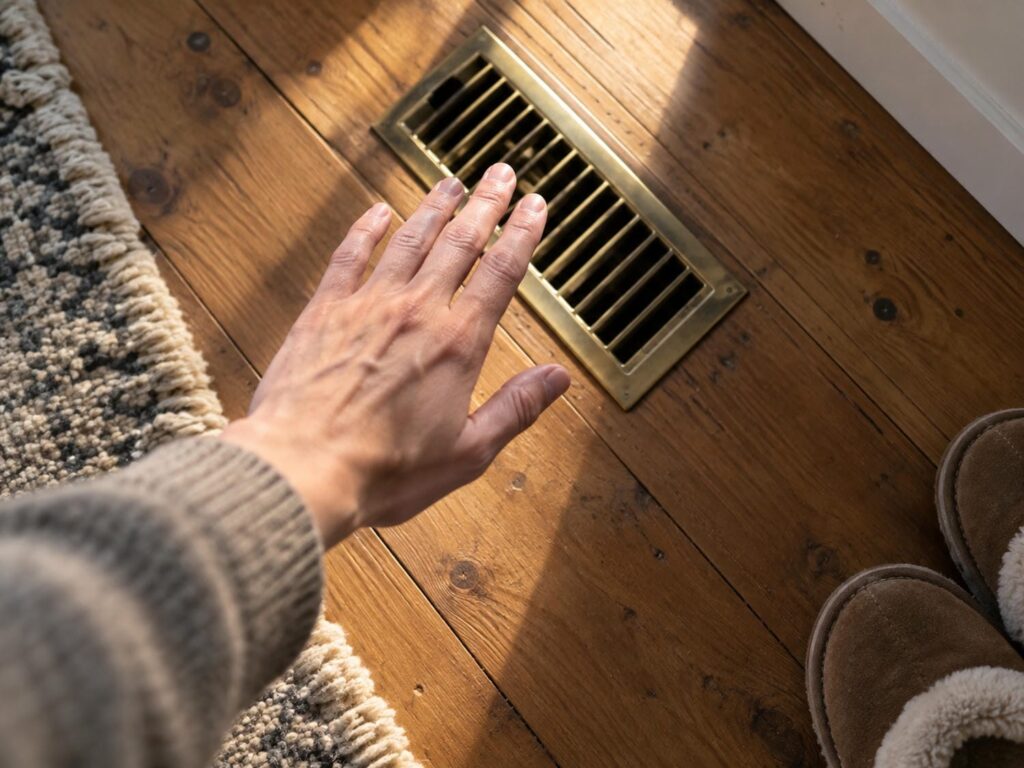
This is the question homeowners actually want answered, and it has a plain answer. Three mechanisms explain almost every “it was fine again by breakfast” story. A fourth explains why the problem keeps coming back after you thought you had dealt with it.
The Furnace Stops Trying, Then Starts Trying Again on Its Own
Modern controls do not give up when an ignition attempt fails, and they do not keep trying forever either. Gas furnace ignition lockouts follow a set pattern. After the first failure the board tries twice more, the same way. If it still gets no flame signal, it stops trying for 5 minutes. Some controls hold the furnace out for a full hour instead, and release when the power is cut and restored. The board waits only about 5 seconds for the flame to prove itself.
Then the timer expires and the furnace runs the whole sequence again on its own. Nothing was fixed. A clock ran out.
How many tries your furnace makes, and how long it waits before trying again, is set by its own control board. The number for your furnace is in its manual, and it is the reason the thing can be dead at midnight and running at breakfast.
That waiting state is called a lockout: the control refusing to keep pushing gas into a burner it cannot prove is lit. Here is the catch. A furnace that runs again has not fixed itself, it has reset itself. And the thing that stopped it was the thing protecting you.
A Safety Switch That Resets Itself Once the Furnace Cools
You may have watched this. The burners quit, the fan kept blowing cool air, and an hour later everything was fine.
A high limit is a safety switch watching the temperature inside the furnace. When too much heat builds up in the heat exchanger it opens, the gas valve closes, and the blower keeps running to carry the heat away. Once the temperature comes back down the switch closes by itself and the furnace runs. Nothing was repaired.
The switch is not the marginal part. The airflow is. A filter loads gradually, or half the registers get closed off, and the temperature creeps up until one day it crosses the line. Keep overheating and the board eventually stops trying for an hour instead of restarting straight away. That hour without heat is usually when people phone.
Cutting the gas also protects the heat exchanger from cracking, so a furnace doing this is not one to ignore.
Or the Condition That Caused It Simply Went Away
Sometimes nothing inside the furnace changed at all. The trigger left, and the symptom left with it. The wind that had been driving across the vent terminal dropped overnight. The ice that formed on the exhaust pipe during a February thaw and refreeze melted off in the afternoon sun. The basement warmed up once the cold snap broke, and a marginal part came back inside its working range.
None of those is a repair. Every one of them returns with the next cold front.
Do Not Cut the Power Before the Technician Arrives
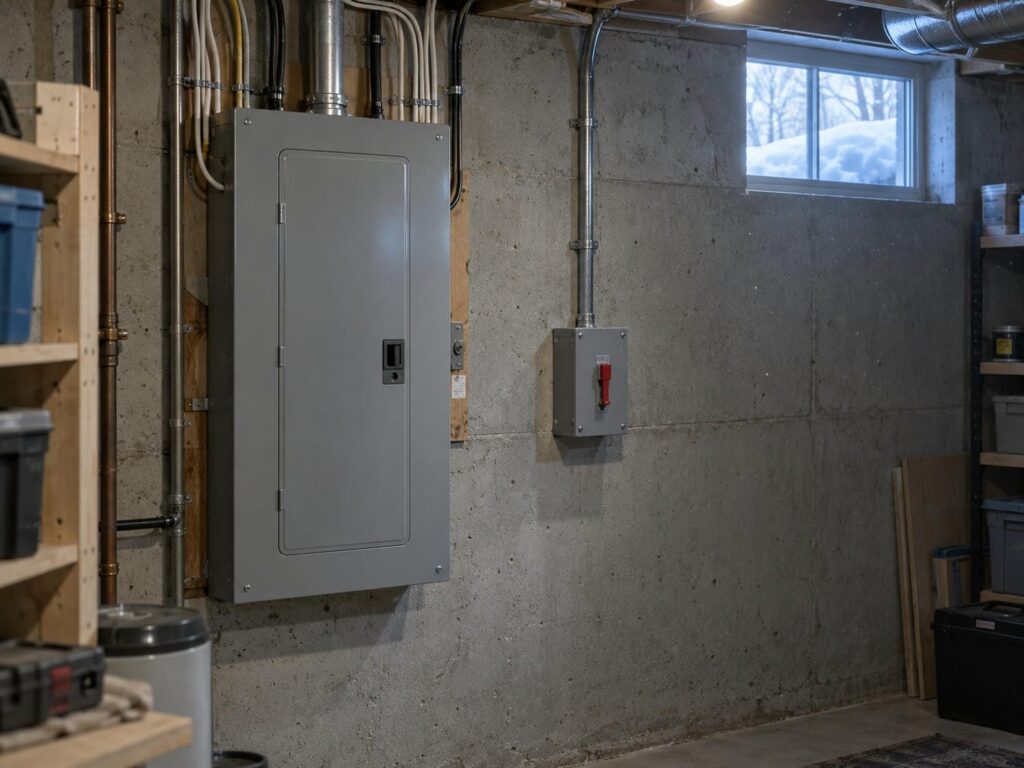
If your furnace is misbehaving and you have a visit booked, leave the power on and leave the thermostat alone. That one instruction saves more diagnostic time than anything else you can do for us. Stop and get out if you smell gas, if a CO alarm sounds, or if you smell burning.
Your Furnace Keeps a Short Record of Its Last Faults
Modern furnace controls store a short list of recent faults, commonly the last 5, and a technician pulls them up with a short press of a button on the board. That list is the closest thing we get to a witness statement for a fault that refuses to happen while anyone is watching. The memory is built to survive a power interruption.
The codes are plain enough once translated: one says the burners lit and then lost flame too many times, another says the pressure switch opened partway through a run, another says the high limit opened. What erases that record is holding the button on the board for more than 5 seconds. That, and not the breaker.
A Reset Takes Away the Fault We Came to See
Here is what actually happens when you cut the power. The furnace comes out of its lockout. It runs. And the fault you called about stops being present, which means the one thing we most needed to observe is gone.
You have not fixed anything. You have made the problem invisible for a while, usually until the next cold night.
So the reason for the instruction is narrower than most people assume. Leave the power on so we can see the fault, not so the memory survives.
Keep a Simple Failure Log Instead
While you wait, write it down. A week of notes on your phone is often worth more than an hour of our time in the basement. Five things, every time it quits:
- The date and time it stopped, and the time it was running again
- The outdoor temperature, and whether it was windy or snowing
- What the thermostat was showing, and whether the fan was still running while the heat was off
- Whether the furnace was trying and failing, or completely silent
- Anything that happened just before: a filter change, a thermostat swap, a power cut
Those five lines tell us whether the pattern follows the weather or the clock.
Four Things to Check Before You Book Anything
These are the cheap answers, and one of them turns out to be the whole explanation more often than people expect. None of them involves opening the furnace.
- The thermostat schedule. A programmed setback looks identical to a random failure when nobody in the house remembers the schedule exists.
- The thermostat batteries. A dying cell is the textbook intermittent fault: it works when it is warm and gives up when it is cold.
- The filter, the returns and the registers. A loaded filter or a set of closed-off registers chokes the airflow, the furnace overheats, and the limit shuts the burners down until it cools. Change or clean filters every 3 months, and keep return air grills and heating vents clear of furniture.
- The vent pipes outside. Walk around the house and look at the plastic pipes coming through the wall. If snow or ice is building around them, clear it with a broom or car brush, never anything sharp.
If the furnace never starts at all rather than only sometimes, work through the full thermostat and power sequence instead.
What the Weather Tells You About an Intermittent Fault
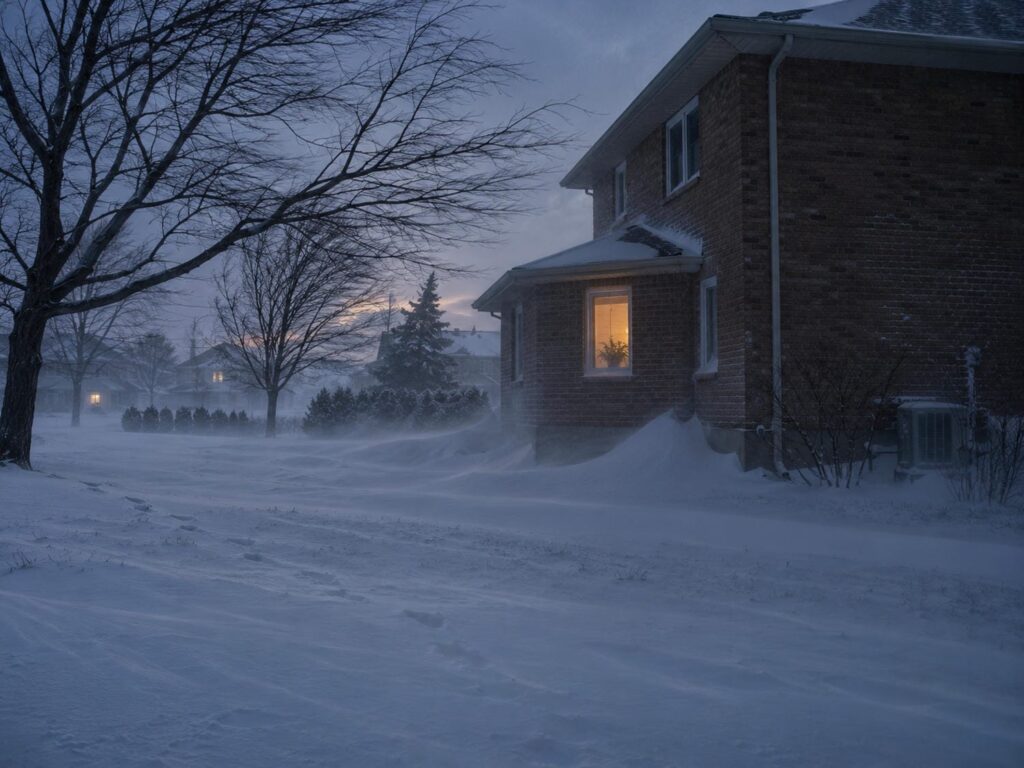
If the failures track the forecast, they were never random. This is the most productive question we ask a homeowner: a pattern that follows the weather points at venting, draft or cold, and a pattern that follows the clock points at the thermostat.
Weather at the Vent Terminal
Two triggers act right at the vent terminal.
- Wind. Strong wind blowing across or into the vent terminal can open a pressure switch for a few seconds, and that is enough to stop the sequence. A switch that opened partway through a run is the fingerprint of wind, not of a broken switch.
- Snow and ice. Side-wall exhaust vents often sit as low as 1 foot above the ground, so they are easy to bury, and a blocked exhaust can let carbon monoxide build up inside the home. Ontario’s regulator and the gas utility both tell homeowners to keep gas meters and appliance vents free of snow and ice.
Installation instructions for a modern high-efficiency furnace call for the vent to clear the average snow accumulation, not just the ground. A vent set to grade works from spring through fall and fails in February.
Cold Nights Push Marginal Parts Over the Line
Environment and Climate Change Canada’s 30-year normals for the Kitchener-Waterloo station put January at about -6°C on an average day, with lows near -10°C, and the station has recorded January nights as cold as -31°C. Cold raises the load on the whole system, and parts that were coping stop coping.
Electrical parts and bearings do not always behave the same warm as they do cold. A motor or capacitor on its way out can start in a warm basement in October and refuse in January, which is why we test the part rather than watch it work once. The coldest night of the year is exactly when a marginal furnace quits, at 3am, with the pipes at risk.
A high-efficiency furnace also makes water every time it runs, and that water has to get out. Anything that stops it belongs on the list when the failures track the weather.
The Parts and Conditions That Fail at a Threshold Rather Than Outright
These are the things that produce “works some days” rather than “does not work”. Each has a long middle period where it is degraded but still just good enough. That period is where you are living right now.
The Flame Sensor, the Classic Case of Works Until It Does Not
A flame sensor is a thin rod sitting in the flame that checks a flame is actually burning every time the system starts. It fails by accumulation, not suddenly. Residue and oxidation build on the rod over time and gradually stop it reading the flame properly.
The symptom is unmistakable once you know it. The burners light, run for a few seconds, and shut off. The furnace tries again, and eventually it locks itself out. Cleaning is not always the answer either. If the furnace keeps shutting down after a cleaning, the sensor gets replaced rather than cleaned again.
The Rest of the List, and What Each One Does When It Is Marginal
The same logic runs through the rest.
- Restricted airflow against the high limit. The switch is fine; the airflow is what went marginal, and a filter loads up over months.
- Pressure switch against a marginal vent. A sagging pipe holding water or a gust across the terminal drops the draft below its set point for a moment.
- Hot surface ignitor near end of life. An ignitor that still glows is not automatically a good one. It is measured against the manufacturer’s published range, and one outside it gets replaced.
- Draft inducer. Stiffening bearings or buildup on the wheel can let it spin up to speed on some starts and not others.
- Capacitor or blower motor. A motor or capacitor on its way out can start warm and refuse cold.
- Control board and connections. Electronics can fail as they heat up and behave again once they cool, which is one reason a single quiet visit does not settle the question.
- Loose or corroded wiring and grounding. A furnace needs a good ground and tight chassis connections, because flame sensing depends on that ground path. A poor ground produces flame faults that look like a dirty sensor.
- The thermostat side. Smart thermostats want steady power. Where there is no common wire the thermostat borrows power from the heating circuit, worth checking when the thermostat is the thing acting oddly.
Match the Pattern to the Likely Cause
The shape of the failure is the most valuable diagnostic information you own. You do not need a meter to narrow this down. You need to notice when it happens, because “only on cold nights” and “at the same time most days” point at completely different parts of the system.
| When it fails | What that pattern usually points to | What we check first |
| Only on cold nights or in a deep freeze | Venting, condensate, or a part that only misses its mark when it is cold | Vent terminations, draft, ignitor and flame signal under cold conditions |
| Only when it is windy | Draft at the terminal dropping for a few seconds | Whether the pressure switch opened during a run, and where the vent terminates |
| Right after a snowfall | A buried or partly iced intake or exhaust | The outdoor terminations, and whether they sit above the snow line |
| It lights, runs a few seconds, quits, then tries again | The furnace is not proving flame | Flame signal under load, sensor condition, and the ground path |
| At the same time most days | A thermostat schedule or thermostat power problem | The programmed schedule, batteries, wiring and the common wire |
| The burners quit but the fan kept blowing, then it was fine an hour later | The furnace overheated and its high limit shut the gas off, usually because airflow is restricted | The filter, blocked returns and registers, the temperature rise, and the stored limit code |
| No pattern anyone can find | A loose connection, electronics that misbehave once warm, or a component sitting right at its limit | The stored fault history first, then connections and measured readings under load |
The lights-then-quits pattern and the burners-quit-but-fan-runs pattern both sound like a furnace turning itself off, so draw the line carefully. If the furnace shuts down within a few minutes of starting on every cycle, rather than only sometimes, that is short cycling, and it is a different pattern with different causes.
When an Intermittent Fault Stops Being a Comfort Problem
Intermittent does not mean minor. A furnace that fails only in a hard freeze is a furnace that fails on the coldest night of the year. Combustion faults sit on the same list as nuisance faults, which makes some of these a safety question rather than a comfort one.
The Signals That End the Waiting
Three signals end the waiting.
- A gas smell. Everyone out of the house, and call from outside.
- A CO alarm sounding. Get everyone out immediately and call 9-1-1 or your local emergency number from outside the building. A home typically has several fuel-burning appliances, so a sounding alarm is not automatically the furnace.
- A cracked heat exchanger. A crack can put combustion gases into the air you breathe. That is not something to watch for another week. Shut the furnace off and book a visit.
Short of those three, while the furnace is only failing to start and your CO alarms are working, it is reasonable to keep heating the house.
Ontario Requires a CO Alarm on Every Storey
Ontario’s carbon monoxide alarm requirements put an alarm adjacent to each sleeping area and on every storey of the home, including storeys with no bedrooms. The rule applies to any home with a fuel-burning appliance, a fireplace, or an attached garage, which describes almost every house with a gas furnace in this region.
Carbon monoxide has no smell, taste or colour, so an alarm is the only thing that will tell you it is there. More than 65 percent of Ontario’s CO injuries and deaths happen in homes. Test the alarms at least monthly. How the rule applies to your particular house is your local fire department’s call.
What We Do Differently When the Fault Is Not Happening
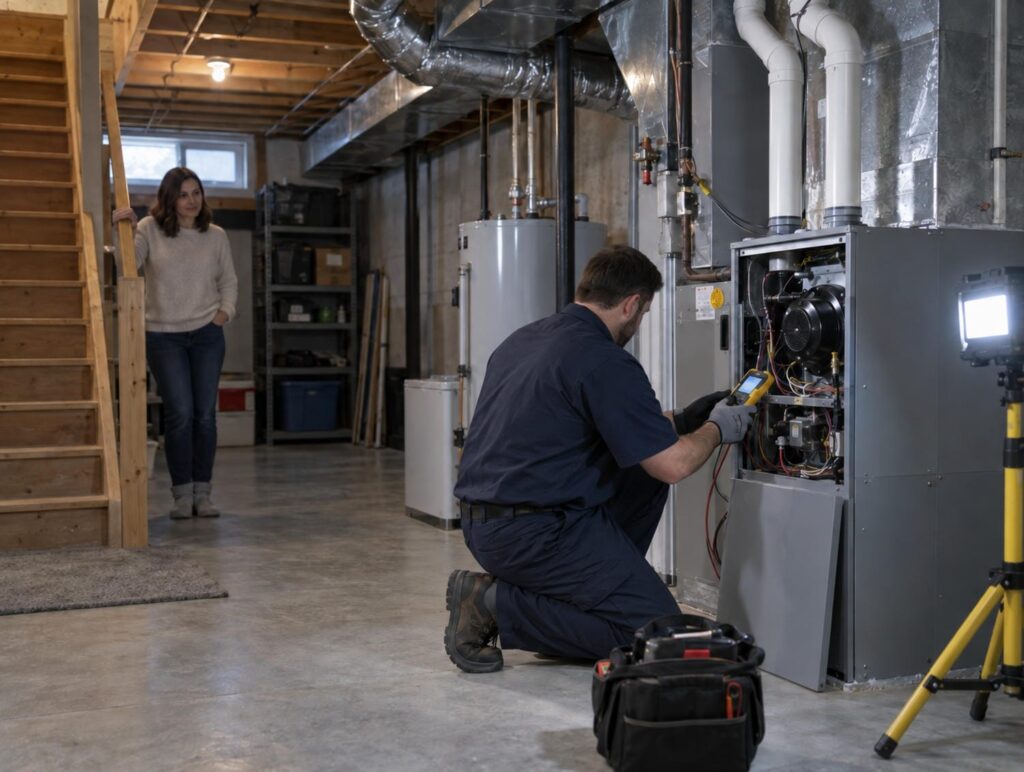
You are probably worried we will arrive, watch one clean cycle, shrug, and bill you. Fair. Diagnosing a fault that is not happening is a different job from fixing one that is, and it has a method.
We Read the History Before We Touch Anything
Our first move on arrival is the stored fault list and whatever the board is showing, before anything is opened, cleaned or reset.
A code saying the burners lit and then lost flame too many times sends us to the flame side. A code saying the pressure switch opened partway through a run sends us to the venting side. A code saying the high limit opened sends us to airflow. Three codes, three different directions. And an overheat that has already cleared itself still leaves its code behind, which is the whole practical value of the record.
We Measure Instead of Guessing
On an intermittent call, pass-or-fail checks are close to useless, because the part is not dead. Numbers are the point.
Temperature rise across the furnace. Flame signal in microamps under load, against the minimum the control needs. Draft. Ignitor resistance against the manufacturer’s published band. Capacitor value against its rating. Voltage and ground at the board.
A reading that sits inside the range but at the very bottom of it is often the answer. A pass-fail check would have called that part good and moved on. We take those readings with the furnace running and loaded, because a marginal part looks fine cold.
We Run It Long Enough for the Fault to Show
Watching one clean cycle proves nothing, and an overheating fault in particular will never appear in a 5-minute visit. So we run the furnace, load it where we can, and give the fault a chance to show up.
Here is the candid part. The temptation on these calls is to replace the usual suspect and leave. Swapping a flame sensor on a furnace that is actually losing draft buys the homeowner about a week. Some intermittent faults take a second visit, which is why the stored codes and your own notes matter.
What Makes an Intermittent Fault Cheap or Expensive to Fix
One variable moves the number more than any other: whether the fault is still present, and still findable, when we get there. Everything else about the cost of chasing an intermittent fault follows from that.
What Makes It Cheap and What Makes It Expensive
Four things move the price.
- Whether the furnace is still misbehaving when we arrive, or whether a reset put it back to running
- Whether the failures are documented with times and conditions, or described as “sometimes”
- Whether it is one marginal part, or a venting problem built in at installation
- Whether the fix is a filter and a set of open registers, or a component replacement
The cheap-looking route is to replace the part that usually causes this symptom. That is a gamble on a furnace that has already proven it does not fail predictably. The cheap visit and the cheap outcome are rarely the same visit.
When to Stop Repairing
Age matters, but no published lifespan number settles the repair-or-replace call. What settles it is how often the furnace fails, what each visit costs you, and whether the failures are safety-related. Two or three intermittent faults in one season on an older furnace is a different conversation from one flame sensor. And a furnace that keeps overheating is on a shorter clock than one that keeps missing ignition, because the risk sits in the heat exchanger.
The Version of This You Can Prevent
Have the furnace inspected once a year by a technician working for a TSSA-registered contractor. That is the interval Ontario’s safety regulator and the gas utility both put in front of homeowners, and it is the one to follow.
Three things keep the intermittent version of this away. Change the filter on schedule. Keep returns and registers clear. Keep the outdoor terminations clear through the winter.
Annual furnace maintenance is also where a marginal part gets caught while it is still marginal. In the trade, the most common thing behind a furnace that keeps locking out is maintenance that never happened.
Get a Straight Answer on a Furnace That Only Sometimes Works
Intermittent faults are the ones most often misdiagnosed by parts-swapping, because the furnace behaves while anyone is watching. We work them the other way round: read the record, measure under load, and find out which threshold is being missed. Local Heating and Cooling has served the Kitchener-Waterloo area for over 10 years, with offices in Kitchener and Waterloo, and we are an Authorized Lennox Dealer. Gas work in Ontario is a regulated trade, so a furnace repair belongs with a registered contractor rather than a weekend fix.
When you are ready, book a visit with our team and tell us when it last quit. And leave the power on until we get there.
Frequently Asked Questions
A part or a condition is sitting right at its limit rather than broken outright. Whether it passes depends on things that change day to day: how cold the night is, which way the wind blows, how loaded the filter has become. On a good day it clears the threshold. On a bad day it does not, and the control stops the sequence.
Two things usually explain it. Either the lockout timer expired and the control ran the whole ignition sequence again by itself, or a safety switch that opened on overheating closed again once the furnace cooled down. Nothing was repaired. The condition that stopped it is still sitting there, waiting for the next cold night or the next loaded filter to bring it back.
Not before a technician sees it. Cutting the power brings the furnace out of its lockout, so it runs again and the fault we came to find stops happening. You get heat for a night and we lose the one thing that would have shown us which threshold was being missed. If you have a visit booked, leave the power on.
Yes, usually. The control board stores a short list of recent faults, and that record tells us which part of the sequence failed. Measured readings under load do the rest: flame signal, temperature rise, draft, ignitor resistance, capacitor value. Add your notes on when it failed and what the weather was doing, and the picture is usually clear enough to act on.
It can be. Some intermittent faults are combustion faults, and those are a safety question rather than a comfort question. A blocked exhaust vent can let carbon monoxide build up in the house. And a furnace that only fails in a deep freeze is a furnace that fails on the worst possible night, at 3am, with the pipes at risk.
It is common, and it is useful information. A failure that tracks the weather points at venting, draft or condensate rather than at a random electrical fault. Wind across a vent terminal can open a pressure switch for a few seconds. Tell us the outdoor conditions each time it quits and you have narrowed the search for us.
Age alone does not settle it. How often the furnace fails, what each visit costs you, and whether the failures are safety-related do. One flame sensor on an otherwise sound furnace is a repair. Two or three intermittent faults in a single season, on a furnace with a venting or heat exchanger concern, is the point where replacement deserves a serious look.
Usually yes, while it is only failing to start and your CO alarms are working. That is the ordinary case. Stop and get out if you smell gas, if a CO alarm sounds, or if you smell burning, and call from outside. Those three change the answer completely, and they are worth agreeing on with everyone in the house.