
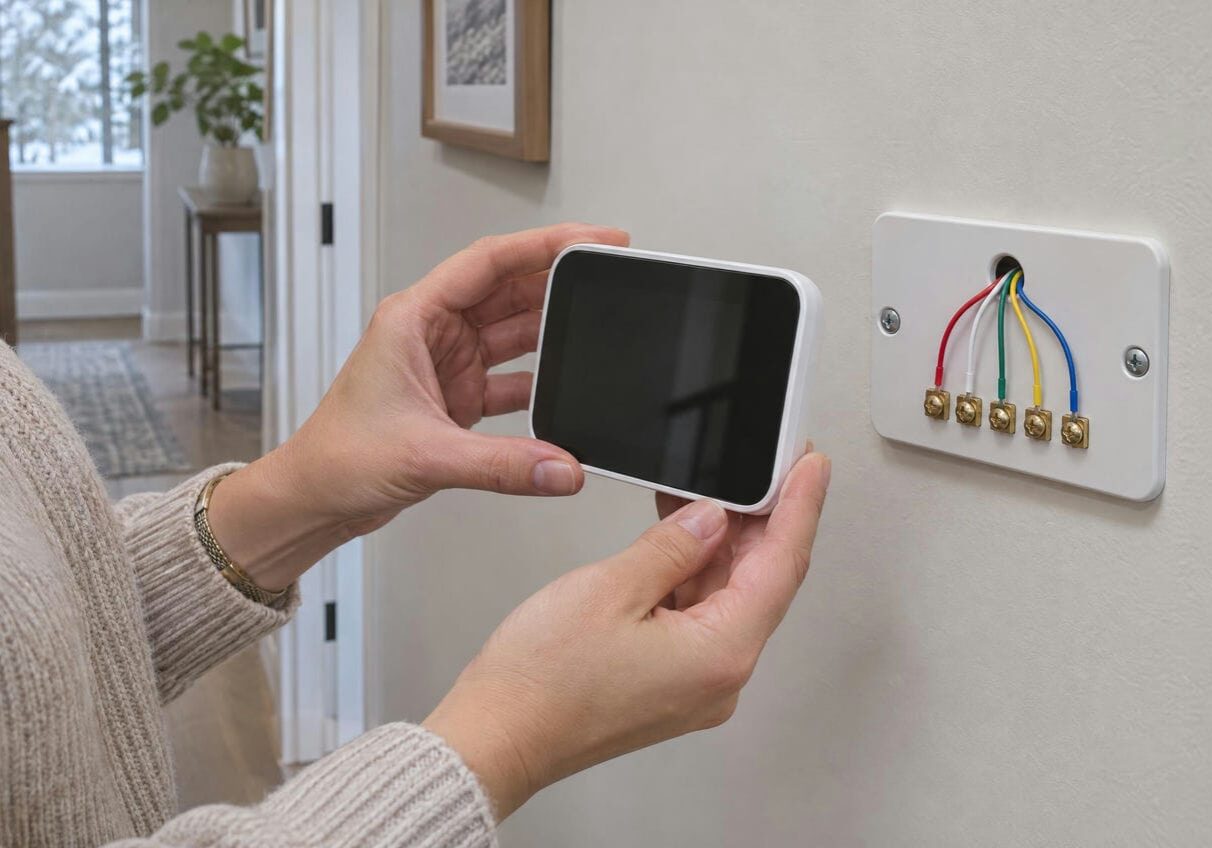
A furnace not working after a thermostat replacement is almost always a low-voltage problem the swap created rather than a furnace that failed the same week. In one version of this, the furnace has been silent since the swap, often with a blank screen on the wall. In the other it still runs. It short cycles, refuses to shut off, runs the blower constantly, or never catches up on a cold night.
There is no single cause behind every one of these calls. The list is short: a wire on the wrong terminal, a missing common wire, a fuse that gave way, a setting the new thermostat was never given, or a battery tab that never came out. A furnace diagnosis on this call traces the control wiring at both ends. We also check what the new thermostat was told about the furnace.
The fault sits in the wiring, the low-voltage supply or the setup answers, not in the way the furnace burns gas.
Two Different Problems After a Thermostat Swap
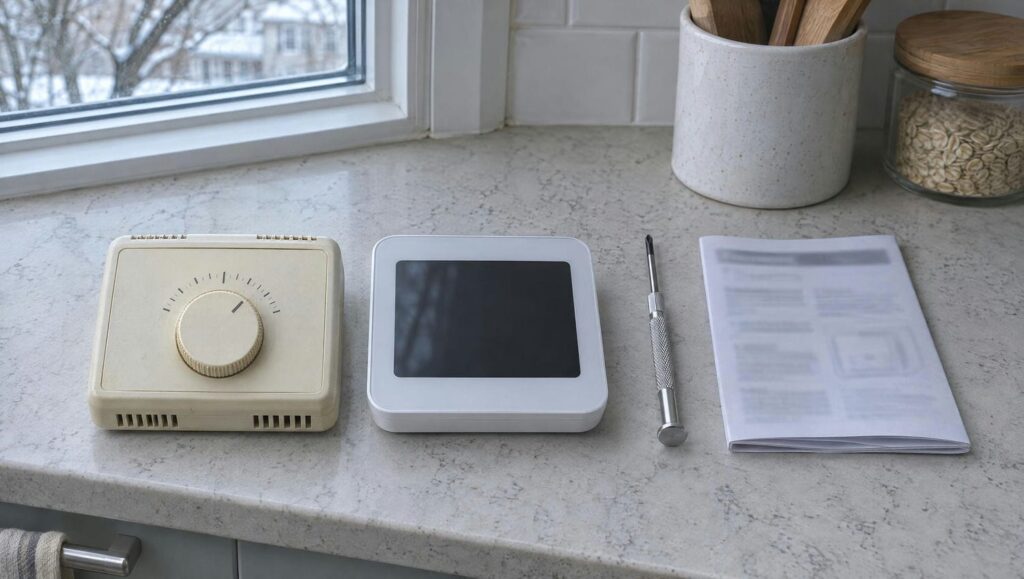
A furnace that has been dead since the swap points at the 24 volt supply between it and the thermostat. A furnace that runs wrong since the swap points at what the new control was given. That is either steady power or the right setup answers.
Check the furnace’s own switch is pushed fully to On, then give the breaker one cycle. A furnace that will not turn on at all has a longer list of causes than a thermostat swap. The full power and safety switch checks are the ones to work through in order.
If the new thermostat is a battery-powered model, check the battery tab came out completely and that no piece of it is still on the contacts. The manufacturer lists exactly that as a reason a new thermostat will not power up during setup. Then check the batteries are seated firmly and the right way round. Some thermostats are battery powered only, with no common wire option. On those models the batteries are the whole power supply.
A blank screen and a silent furnace look the same from the hallway, and the difference decides who fixes it. On a battery-powered thermostat, a tab left on the contacts leaves the screen dead and the furnace with no call for heat, and the furnace itself still has power. On a thermostat powered from the furnace, a blown fuse on the control board takes away the low-voltage supply as well.
Turn the power off before you expose any wiring. Remember that a heating and cooling system can sit on more than one breaker. One breaker being off is not the same as the power being off. The manufacturers give the reason as protecting the furnace and the thermostat from damage.
To confirm the power is really off, move the setpoint at least 5 degrees. Wait 5 minutes to see that nothing starts.
If the old thermostat and its jumper are still in the drawer, putting the working control back on is the fastest route to heat tonight. You can arrange the right fix afterwards. The same symptom can belong to you or to a technician. Which one it is depends on what the swap changed rather than on how bad it looks.
| What You Are Seeing Since the Swap | What the Swap Changed | Who Can Put It Right |
| The thermostat screen is blank and the furnace is silent | The thermostat has lost its power supply, which on a battery-powered model points to the tab or the batteries, and on a model powered from the furnace can be a fuse on the control board | The tab and the batteries are yours to check. A fuse on the control board is ours |
| The screen is on, but nothing happens when you raise the heat | The heat wire is not on the terminal the furnace expects. On a thermostat with push-down connectors rather than screws, a wire can also sit in its hole with the latch open, and the thermostat then behaves as though that wire is not there | On a thermostat with push-down connectors, you can check every latch is closed. We check which wire landed where at the furnace end |
| The thermostat reboots, drops off the Wi-Fi, or clicks | The thermostat has no steady 24 volt supply, because the house has no common wire or one was improvised | Ours. We run a common wire or fit the manufacturer’s own power accessory |
| The blower runs all the time, or starts when nothing asked for heat | The fan wire was landed wrong or borrowed to improvise a common wire | The fan setting on the thermostat is yours to check. We check the fan wire at both ends |
| The furnace starts and stops every few minutes | The cycle rate the new thermostat is carrying does not suit the furnace | Ours. We set the cycle rate to suit your furnace, and on some models the thermostat picks it from the setup answers instead |
| The house never catches up on a cold night | On a two-stage furnace, the thermostat is not driving the second heat stage, so the furnace runs on low output only | Ours, with a thermostat that drives staging |
What the Thermostat Wires Do and What Moving One Changes
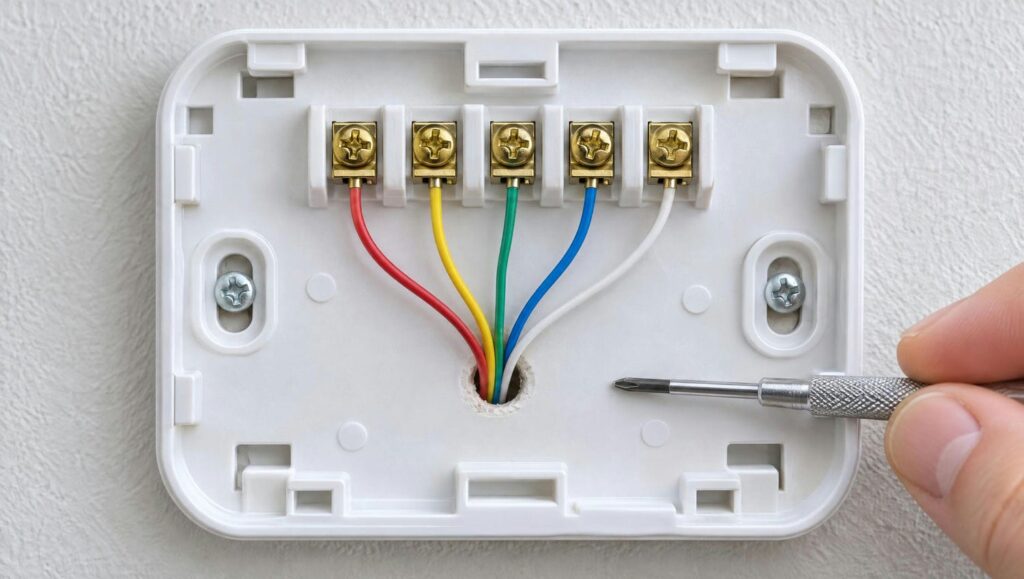
The wiring between your thermostat and your furnace is a 24 volt control circuit, which means it carries switching signals rather than house power. On a conventional gas furnace those signals do nothing but turn parts of the furnace on and off. Each lettered terminal carries one signal.
R, Rh and Rc: The Power Terminals and the Jumper Between Them
The R terminal is where the furnace sends 24 volt power up to the thermostat. Every other wire at the thermostat is a switch that sends some of that power back down. If your old thermostat had both an Rh and an Rc wire, your house has two power sources, one for heating and one for cooling. You set the new thermostat up for two power sources rather than for a single R. Where only one of them is present, that one wire powers both.
On a single-transformer system, the old thermostat often had a small metal jumper linking its two power terminals. A Nest makes that connection inside itself, so the jumper does not get carried across to one of those. Check your new thermostat’s instructions before you leave the jumper out.
W, Y and G: The Wires That Call for Heat, Cooling and Fan
W or W1 controls the heating system, Y or Y1 controls cooling, and G or G1 runs the blower on its own. A wire moved one terminal across does not break the furnace, it makes the furnace do the wrong job. A heat wire landed on the fan terminal gives you a blower and no heat.
A wire on the O/B terminal belongs to a heat pump’s changeover valve. On a gas furnace with no heat pump, that terminal normally has nothing on it.
Why the Thermostat May Not See a Wire You Connected
On a thermostat with push-down connectors rather than screws, a wire can sit in its hole without the latch closed. With the latch open, the thermostat behaves as though that wire is not there at all.
Two instructions do most of the work at the terminals. Use one wire per connector, and never land a spare wire that was not connected to the old thermostat. Google is explicit that more than one wire in a connector can damage both the system and the thermostat. A spare conductor in the wall may have been left for a common wire, may be connected at the furnace, or may be connected to nothing.
The Common Wire: Which Systems and Which Thermostats Need One
The common wire, which is the wire that gives the thermostat steady power, does not make the furnace do anything. That is why a system can heat perfectly well on an old dial thermostat and then misbehave the week a smart one goes on the wall. Heating-only systems, cooling-only systems, zoned systems and heat pumps need a common wire or a compatible power accessory. No setting gets around that requirement. Honeywell Home’s Wi-Fi thermostats all require one.
What a Thermostat Short of Steady Power Does
A thermostat short of steady power can misbehave rather than fail outright. What that looks like is specific: battery life drops, the display will not turn on, and the Wi-Fi disconnects. The system also cycles when nothing asked it to, and the thermostat chatters, stutters or clicks. The same behaviour includes heat that is always on or repeatedly cycling, a delayed-start message on the screen, and problems with the fan. Every one of those looks like a furnace fault, even though the control on the wall is the part that is struggling.
The Two Proper Fixes When the Wall Has No Common Wire
The manufacturers publish two routes. Connect an unused conductor that is already in the wall to the C terminal. The other route is the manufacturer’s own adapter, which repurposes the fan and the cooling wires. Either route has to be finished at both ends, at the thermostat and at the furnace control board. Google publishes the same pair of options for a house with no common wire: have one run, or fit the power accessory made for the thermostat.
Because that adapter repurposes the fan and cooling wires by design, the fan wire is one to check when a common wire was improvised instead. A borrowed wire that was changed at one end only can show up as why the blower runs constantly.
The Low-Voltage Fuse on the Furnace Control Board
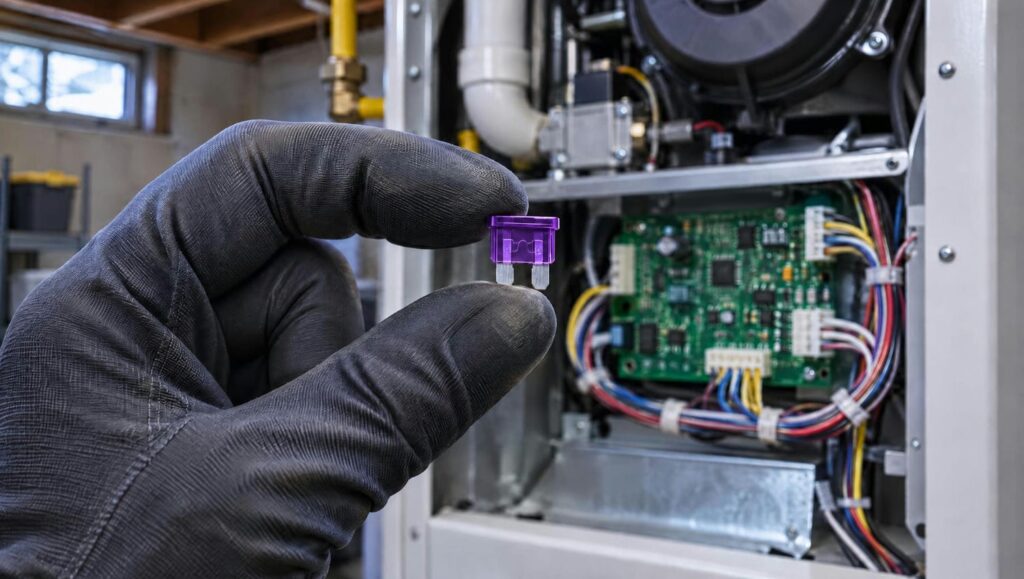
The system’s fuse usually sits on the furnace control board, which is the circuit board inside the cabinet. A blown fuse can stop power reaching the thermostat. When it goes, the screen and the furnace go quiet together. A swap can then leave you with a blank screen and no error code.
Two bare conductors touching, or a wire pushed onto the wrong terminal at the furnace end, puts the transformer across a short. The fuse is the part designed to give way first. After a swap, wiring that is not correct is one of the published causes of a thermostat reporting no power. It is the one worth checking first.
The fuse itself is small, it is specific to your furnace, and the right replacement is the one the furnace’s own manual calls for. Fitting a larger one lets the next short do its damage somewhere more expensive than a fuse.
Telling the New Thermostat What It Is Controlling
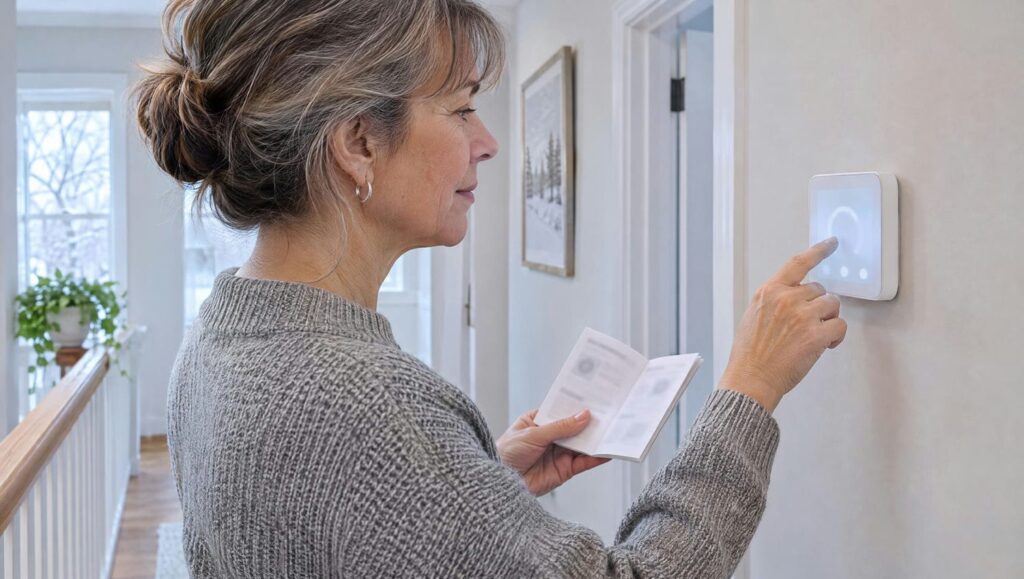
Modern thermostats are configured as well as wired. Wrong answers at setup do not usually produce an error message. Two behaviours point at the setup rather than at the power supply: heat that will not shut off, and heat that cycles every few minutes.
The Equipment Type You Enter During Setup
A new thermostat asks what kind of heating the house has before it will run anything. If that answer is wrong, the thermostat will not control the furnace correctly. Nothing on the screen says so, because as far as the thermostat is concerned it is doing its job. A heat pump setting entered on a gas furnace is one way that happens.
A wrong equipment type is a settings problem rather than a wiring problem. You correct it in the thermostat’s own settings rather than at the furnace. The wires can stay where they are while you work through the setup menu again.
Cycle Rate and a Furnace That Starts and Stops All Evening
Cycle rate is how many times an hour the thermostat is willing to start and stop the furnace. Honeywell Home puts a typical mid-efficiency forced air furnace at about five cycles an hour under normal load. It puts a high-efficiency furnace at fewer than that.
If your furnace has started and stopped all evening since the swap, check the cycle rate setting before you assume a part failed. What short cycling means for the furnace is the same either way. In our experience it leaves more wear on the ignition parts and a house that heats unevenly.
The right cycle rate depends on the type of system and the weather it is working in. The installer sets it rather than leaving it on the factory default. On some models the thermostat picks the cycle rate itself from the system details entered at setup. On those models, a wrong setup answer shows up later as a furnace that cycles oddly.
Two-Stage Furnaces and the Second Heat Wire
On a two-stage furnace the second heat stage has its own wire, W2. A thermostat that is not driving that wire leaves the furnace running on low output only. The complaint after a swap is then that the house never catches up on a cold night rather than that the furnace failed.
Staging, which means the furnace has a lower and a higher output, is not standard equipment on a thermostat. The Nest Learning Thermostat drives three heat stages, and the Nest Thermostat drives one plus a second. The model decides how much of your furnace gets used. Which of those you own matters, because how single-stage, two-stage and variable speed furnaces differ sets what the control has to do.
Communicating Furnaces Like Lennox iComfort and the Thermostats They Accept
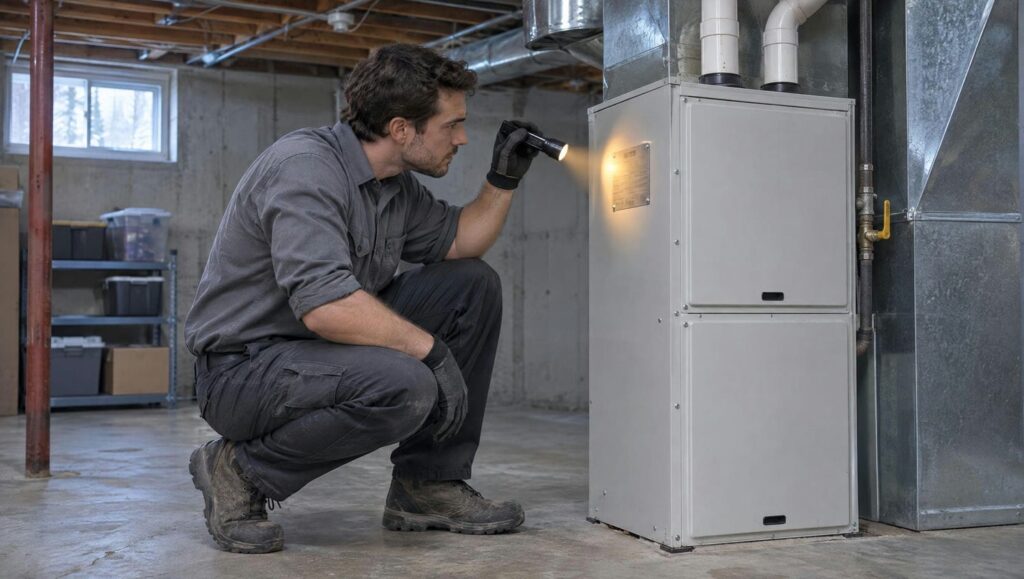
On most furnaces the thermostat sends simple on and off signals down separate wires. A communicating system works differently, and a homeowner who has one has a question that no amount of wire checking will answer. We are an Authorized Lennox Dealer, so we work on this equipment regularly.
What a Communicating Furnace Is and What It Will Accept
A communicating furnace and its thermostat are built to exchange information over a small data connection rather than through separate on and off wires.
A Lennox SLP98V is built to exchange information with an iComfort thermostat and to vary its output anywhere from 35 to 100 percent. A thermostat that can only say on or off is not a smaller version of the right control. It is a different kind of control.
Lennox’s S40 thermostat works with premium Lennox communicating equipment only. The S30 needs an extra interface module before it will run a conventional system at all. It will not work with another brand’s communicating equipment. Trane states it both ways round for its own communicating control: it runs Trane variable speed communicating systems, and it will not run another brand or an ordinary single-stage, two-stage or multi-speed system.
If your furnace is premium Lennox communicating equipment, the control it came with is the control it runs on.
How to Tell Whether Your Furnace Is a Communicating System
Look at the labels on the terminals the old thermostat came off. An ordinary system labels them by function, with letters like R, W, Y and G. If the labels run as a plain sequence instead, 1, 2, 3 or A, B, C, the system is proprietary. A general-purpose thermostat is not made for a proprietary system. That check takes a minute with the thermostat off the wall.
Google publishes a compatibility checker you can run yourself before you buy, and it works from the wire labels on your existing thermostat.
The thermostat that came off the wall tells you something too. Lennox sorts its own thermostats by whether the equipment communicates, and it says so in each product’s description. The E40, M40 and L40 are the models it calls universally compatible for non-communicating equipment, and the S models are built for its communicating systems. A communicating system also tends to carry the furnace maker’s own branded control. It presents fewer wires than a conventional terminal block, because it needs only power and a small data pair.
Lennox has discontinued the iComfort S30 and the older iComfort Wi-Fi, and it points to the S40 as the replacement. The like-for-like swap you expected may not be available. In our experience that is how a general-purpose thermostat ends up on the wall of a communicating system.
The furnace model and serial are printed on a rating plate on the cabinet. The model settles the question, and on a Lennox system we can confirm it from that number. On a communicating system the thermostat and the furnace are a matched pair. The answer there is the right thermostat rather than a different setting.
Where the New Thermostat Ended Up on the Wall
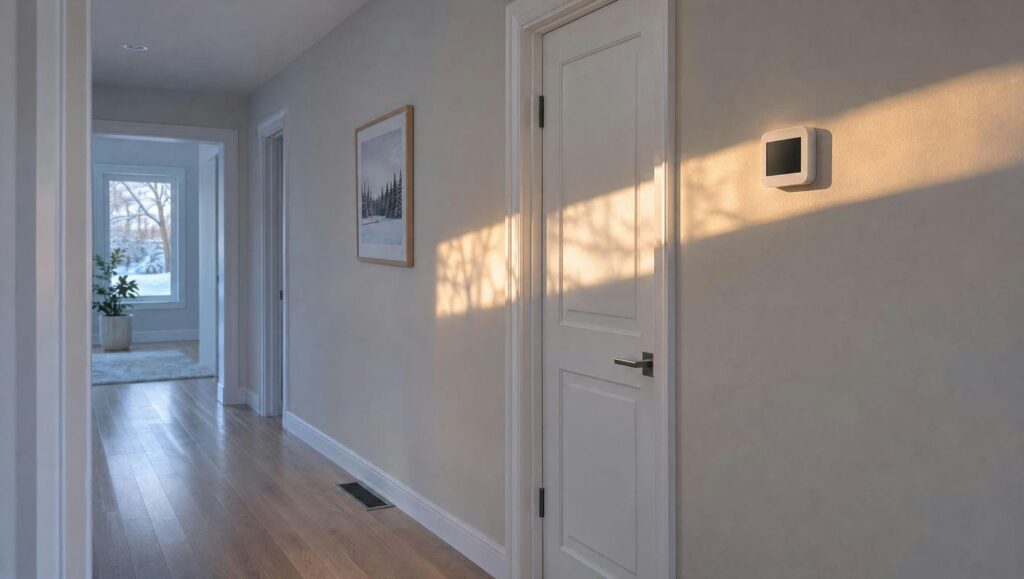
Save on Energy puts a thermostat on an interior wall in a room you actually use, clear of vents, windows, doors and direct sunlight. That guidance also puts it clear of anything that gives off heat, such as a lamp, a television or a kitchen appliance. A thermostat in the wrong spot reads the room falsely and runs the system when it does not need to run.
A thermostat is built to hold the room close to the temperature you set. A house that now swings noticeably warm and cool is telling you something about the new control rather than about the furnace.
A thermostat moved to a different wall can also read a few degrees away from what the old one read. You may then conclude the furnace got weaker. The furnace is doing what it did last week, and the room it is measuring has changed.
Ontario’s Rules on Gas Work, and Who Decides on Electrical Work
Changing a thermostat puts you at the wall rather than inside the furnace. That distinction matters in Ontario, because the two have different rules.
In Ontario, only a TSSA-registered fuels contractor is legally allowed to do gas work, and the register is public, so you can look up a company before anyone opens your furnace.
Electrical work is governed separately, and the rule is written broadly. The Electrical Safety Authority says the Electrical Safety Code requires almost all electrical work to be reported to it by filing a notification of work before the work starts. ESA’s do-it-yourself guidance says that only you may do electrical work in your own home, and that a friend, a family member or a neighbour may not do it for you.
Running new wire, moving a circuit, or fitting a line-voltage thermostat for electric heat is electrical work. We send that work to a licensed electrical contractor, and we recommend you do the same.
The Electrical Safety Authority decides whether a particular job needs a notification, and it is the body to ask before the work starts.
Changing a thermostat does not create a combustion problem. A house with a gas furnace still needs working carbon monoxide alarms on every level and beside every sleeping area, and if one sounds, get everyone out, call 911 from outside, and stay out until firefighters say it is safe.
What We Check When a Furnace Is Not Working After a Thermostat Replacement
On this call we read the wiring at both ends rather than only at the thermostat. We also check the low-voltage supply and the fuse on the control board. Then we confirm what the thermostat was told about the furnace at setup. Last, we confirm whether the furnace will accept the control that went on the wall.
What moves the cost is the scope of the work. Reseating a connector or correcting a setting is a short visit. Replacing a fuse and tracing why it went is more than that. Running a new common wire through finished walls is the expensive version, because of the access rather than the part. If you have learned that your furnace will not accept the control you bought, the expensive route is buying a second thermostat before the model number is checked.
Local Heating and Cooling has worked on furnaces here for over 10 years, from offices in Kitchener and Waterloo. If those checks have not brought the heat back, a furnace repair visit settles it. You can book a diagnostic visit with our team.
Frequently Asked Questions
These are the questions homeowners ask us in the days after a thermostat swap. Most come from a house that is either cold or oddly warm, with a new control on the wall and no error code to explain it.
Yes. A fuse on the furnace control board can stop power reaching the thermostat. When it goes, the screen and the furnace go quiet together. Two bare wires touching, or a wire landed on the wrong terminal at the furnace, is enough to do it. The right replacement is the fuse the furnace’s own manual calls for rather than a larger one.
It depends on the system, and the list is short. Heating-only systems, cooling-only systems, zoned systems and heat pumps need a common wire or a compatible power accessory. Honeywell Home requires one on all of its Wi-Fi models. Where a house has none, the two proper routes are a conductor run to the C terminal or the maker’s own power accessory. Both routes have to be completed at the thermostat and at the furnace.
If the old thermostat and its jumper were kept, yes, and it is often the fastest route back to heat tonight. Photographs of the original wiring make it quicker still. Putting the old control back is a holding step rather than the fix. The reason the new one misbehaved is still worth finding.
Only a thermostat built to drive a second stage will do it. The stage count sits in the thermostat’s own specifications, so you can check it before you buy. The Nest Learning Thermostat is specified for three heating stages, and the Nest Thermostat is specified for one stage plus a second. Check that number against your furnace. A control that cannot reach the second stage will hold a two-stage furnace at its lower output.
No. A conventional Lennox furnace takes a conventional thermostat. Premium Lennox communicating equipment is built around its own control, and the S40 works with premium Lennox communicating equipment only. Two checks tell you which one you have: the labels on the terminals the old thermostat came off, and then the model number on the rating plate on the cabinet.
Gas work inside the furnace is restricted to TSSA-registered contractors, and that part is not a judgement call. On the electrical side, Ontario’s rule is written broadly: the Electrical Safety Authority expects almost all electrical work to be reported before it starts, and ESA is the body to ask about a particular job.