
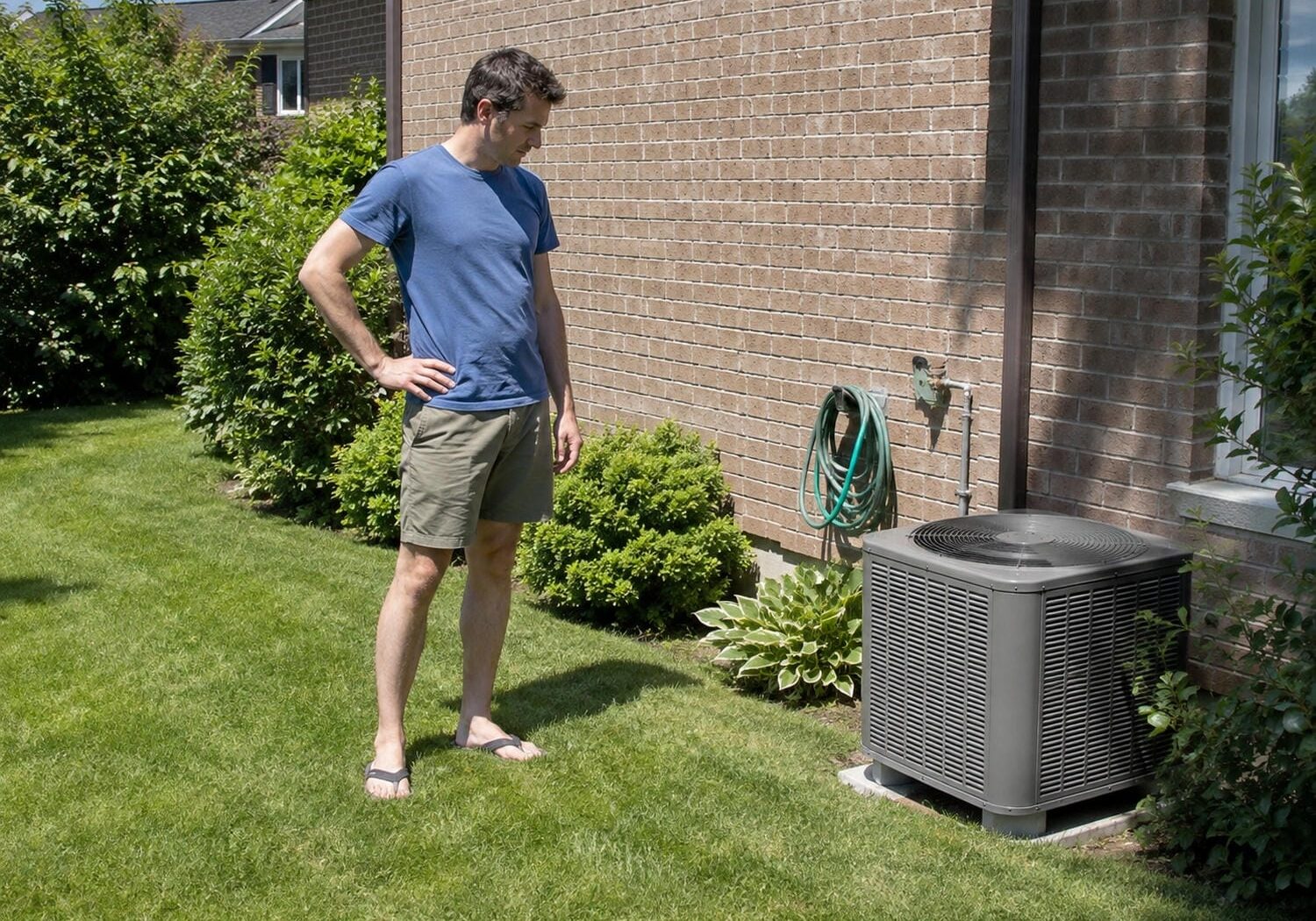
An air conditioner not turning on is almost never a broken compressor or a refrigerant problem. It is a break somewhere in the chain of switches between your thermostat and the outdoor unit, and most of that chain is findable in a few minutes with no tools at all. We check and label that same chain on every air conditioner installation we do, which is why the sequence below is the sequence a technician walks.
Work through the five checks in order. Each one has a plain pass condition, so you always know whether to move on or stop, and the most common false alarm on this whole topic gets settled before you touch anything. One thing to sort out first. If the outdoor unit is humming and air is coming from the vents but the house stays warm, this is not a no-start. That is the case where your air conditioner runs but is not cooling, and it needs a different set of checks.
What an Air Conditioner Not Turning On Usually Means
A silent system is rarely a sick system. In most cases the refrigeration side is perfectly healthy and the instruction to run never arrived, or never completed the trip. That is why guessing at parts is the wrong first move: you are hunting for one open switch in a chain, not a failed component. And if you cool with a heat pump or a ductless system, the same chain applies and the same checks are worth making, in the same order.
Two Circuits, and Both Have to Be Intact
Your cooling system starts on two separate electrical circuits, and both of them have to be whole. A small 24-volt control circuit carries the instruction from the thermostat, through a run of safety switches, and out to the contactor in the outdoor unit. A separate 240-volt supply feeds the outdoor unit itself, so that contactor has something to switch on.
Open either circuit anywhere along its length and the result looks identical from your kitchen: nothing happens, and nothing tells you why. There is no error code and no warning light. So a silent air conditioner is a switch hunt rather than a repair guess, and on a hot Saturday that is good news.
The Sequence, in the Order It Should Be Checked
Work them in this order, because each step assumes the one before it passed.
- Wait 10 minutes before deciding anything.
- Rule out a power outage beyond your house.
- Step 1: Start at the thermostat.
- Step 2: Find the indoor power switches.
- Step 3: Check the outdoor disconnect.
- Step 4: The two breakers behind one air conditioner.
- Step 5: The condensate drain, and the float switch if you have one.
Before You Check Anything: Wait, Then Rule Out an Outage
Two checks cost nothing, need no tools, and end the problem outright for a real share of people. Do both before you go near the electrical panel or the outdoor unit. One of them is a timer you cannot see. The other has nothing to do with your air conditioner at all.
The Compressor Delay That Looks Like a Dead System
Thermostats hold the compressor off for up to about 5 minutes after it stops. That is deliberate. A compressor should never restart against pressure it has not shed yet, and the delay is what protects it. Many thermostats show the delay on screen, usually as a flashing icon or a short delay message, though not every model makes it obvious.
Here is the catch: that clock restarts every time power is interrupted or the thermostat is changed. So the homeowner who flips the breaker, waits 90 seconds, flips it again and declares the unit dead has really diagnosed a timer doing its job. After any power interruption, any breaker flip, or any change at the thermostat, give the system a full 10 minutes before you judge it. A lot of no-start calls end right there.
Rule Out a Power Outage Beyond Your House
Check the lights and outlets elsewhere in the house first. If the whole house is dark, or one section of it is, your air conditioner is not the problem and there is nothing here to fix. Look up the outage map for your local electricity distributor and wait it out.
In Kitchener and Waterloo that distributor is Enova Power, which also covers Wilmot, Wellesley and Woolwich, while other parts of the region are billed by different utilities, so check the one that sends you the bill. And if power has just come back after an outage, turn your branch circuits back on one at a time rather than all at once. A whole panel coming up together can surge the appliances that were left switched on.
Step 1: Start at the Thermostat
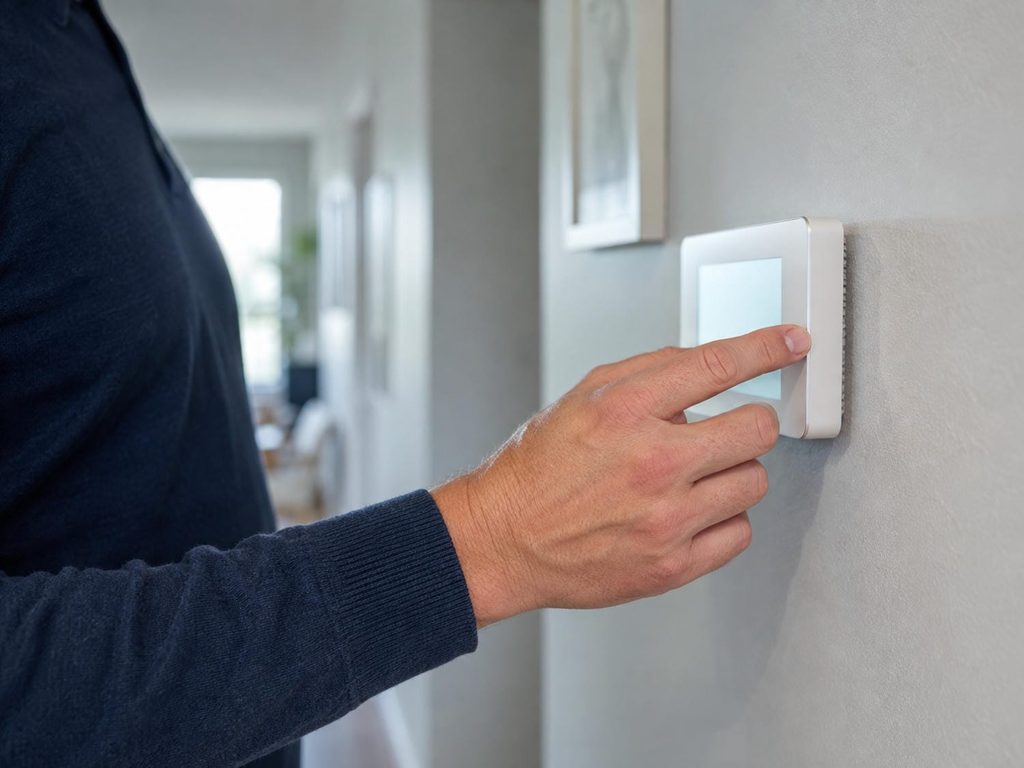
The thermostat is the only switch in the chain you control directly, so the sequence starts there. It is also the one that fails in ways that look like something much worse. Two minutes at the wall rules out more than most people expect.
Mode, Setpoint, and the Gap That Actually Triggers Cooling
Confirm Cool is selected, then read the two numbers on the display. The setpoint needs to sit at least 3 to 5 degrees below the room temperature the thermostat is reading, or the system may never make the call at all. A setpoint one degree under the room reading is the classic version of this fault: nothing responds, and the homeowner reads that as a dead unit. Check that a schedule or a hold is not overriding what you just set, and that a smart thermostat is not sitting in Eco or Away.
The pass condition is simple. The display should show that cooling is on, usually with the words “cool on” or a snowflake icon. If it does not show that, the problem is still inside the thermostat.
What the Display Is Telling You, and What It Is Not
Two things go wrong at the display, and they produce opposite symptoms. A blank screen usually means dead batteries, so fit fresh ones before you assume anything worse. The second one is where people go wrong.
A lit screen is not proof that the system has power. A thermostat runs happily on its own batteries while the 24-volt circuit that carries its instruction down to the equipment sits open somewhere in the basement. The interface works, so the conclusion is that the wiring must be fine and the compressor must be dead. It usually is not. That single misreading pushes more homeowners toward an expensive assumption than any other symptom of a dead air conditioner, and it is why the rest of these checks are worth doing even when the screen looks normal.
Smart Thermostats and the C Wire
A C wire does not control heating or cooling. It does one job: supply constant power to the thermostat. Plenty of systems need one, including cooling-only setups, zone-controlled systems and heat pumps, or they need a compatible power accessory instead.
When a smart thermostat is scraping power from a system that never had a C wire, the symptoms are short battery life and a display that will not stay on. A thermostat that keeps dying stops calling for cooling, and the cause sits entirely upstream of the air conditioner. Watch for this in homes where a smart thermostat went in recently, especially a DIY swap done over the winter, when nobody has asked the system for cooling since.
Step 2: Find the Indoor Power Switches
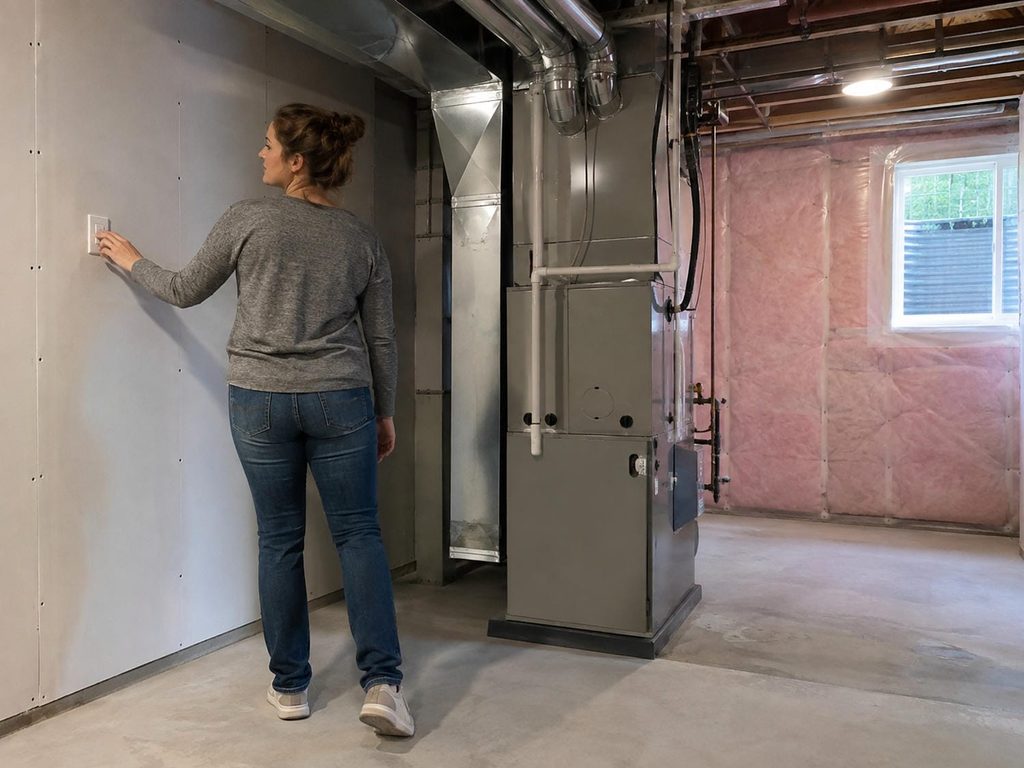
Here is the part that surprises people. In cooling season your air conditioner depends on the furnace or air handler cabinet indoors, because the blower and the low-voltage transformer both live in there. Cut power to that cabinet and the air conditioner dies with it, silently, with nothing at the outdoor unit to give it away.
The Service Switch That Looks Like a Light Switch
There is a switch for the furnace or air handler that looks exactly like a light switch. It sits on the side of the unit, on a nearby wall, or on a ceiling joist, and in a lot of Ontario homes it is at the top of the basement stairs. Ontario’s electrical code requires a separate shut-off near the entrance to the room the furnace is in, which is why an ordinary-looking switch is sitting there in the first place.
Homeowners flip it thinking it is a light, often months before it matters. A dead air conditioner in July very often traces back to a switch flipped in April. Confirm it is on, then give the system a full 10 minutes before you judge the result.
The Blower Door Has to Be Closed and Latched
The blower compartment door is a safety interlock. It is not simply a cover, and with it open or not quite seated the unit has no power at all. This is the after-a-filter-change scenario, and we see it every summer: the panel goes back on, it looks closed, it is actually sitting a few millimetres proud of the cabinet, and nothing has run since. Push it until it sits flush and the latch engages, then wait 10 minutes for the compressor delay to clear. The same switch causes the same silence in heating season, and a furnace that will not turn on gets exactly the same treatment.
The Fuse on the Control Board
Inside the furnace or air handler, a small fuse on the control board protects the low-voltage circuit. When it blows, the thermostat can still light up while nothing else responds, which is precisely the trap from Step 1. Replacing it is a technician’s job, and not because swapping a fuse is difficult.
The fuse did not fail on its own. Something made it fail, usually a rubbed or shorted low-voltage wire, and that something is still sitting there waiting for the next one. So do not open the control board and do not keep a spare in a drawer for this. Recognize the symptom, and stop.
Step 3: Check the Outdoor Disconnect
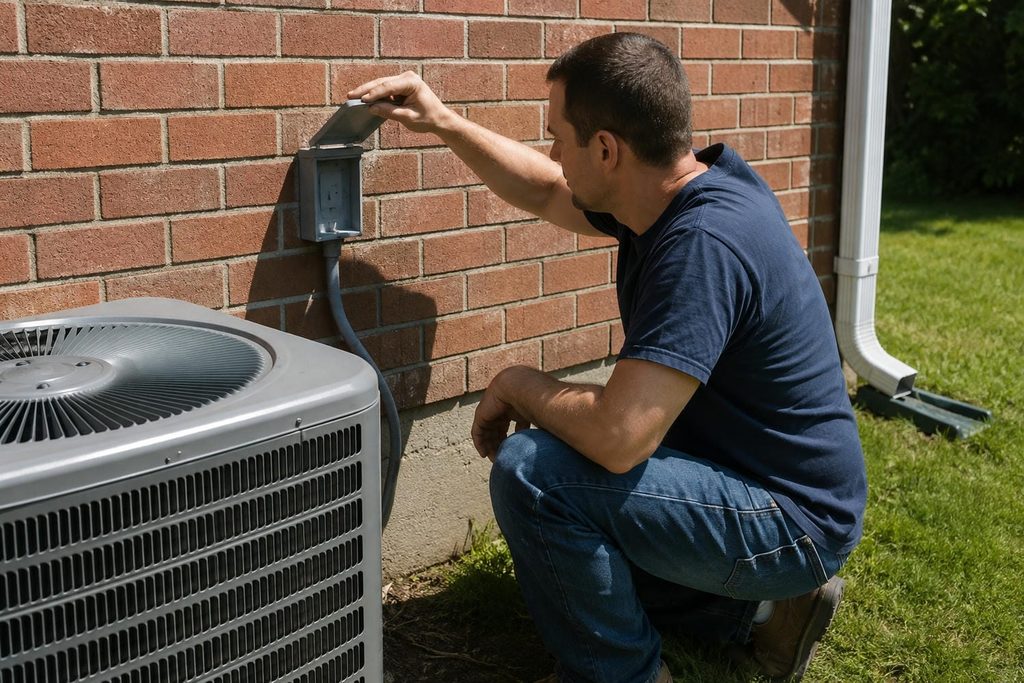
Most homeowners have never noticed the box on the wall beside the outdoor unit. It is a real, findable object, it is there for a reason, and it is the check that generic advice skips. Go outside and look at it before you touch the electrical panel, because it takes 30 seconds and it needs no tools.
Where It Is and What It Looks Like
Ontario’s electrical code requires a way to shut power off close to the outdoor unit, so there is a disconnect within a few metres of your condenser, close enough that you can see it from the unit. It is usually a small metal or grey plastic box mounted on the exterior wall beside the condenser, and inside it is either a pull-out block or a switch. Open the cover and confirm the block is fully seated or the switch is on. That is the whole check. The box exists so a technician can isolate the unit safely before touching it, which is also why it is one of the first things we ask about on a no-start call.
Pulled, Half-Seated, or Corroded
Three ways it fails, and all three are visible. It can be pulled right out and left out, sometimes by whoever last worked on the unit. It can be half-seated, which looks perfectly fine from two metres away and makes no contact at all. Or the block and its contacts can corrode after a winter in a box that faces the weather.
Seat it firmly, then close the cover. But if the block is visibly burnt, blackened or pitted, put it back the way you found it and stop there. That is a component that failed under load, not a component you reseat.
What Winter Leaves Behind
Modern air conditioners are built to live outdoors and generally do not need winterizing. A full cover traps moisture, which rusts components and finishes, and it gives mice and squirrels somewhere warm to spend February. So the spring finds are predictable ones.
A cover still in place. Nesting material inside the cabinet. Thin low-voltage wire that looks gnawed at the point where it enters the unit. If the wiring feeding the unit is damaged, shut that circuit off at the panel, leave it off, and have someone qualified look at it before it is energized again. Damaged wiring on a live circuit is not a wait-and-see item.
Step 4: The Two Breakers Behind One Air Conditioner
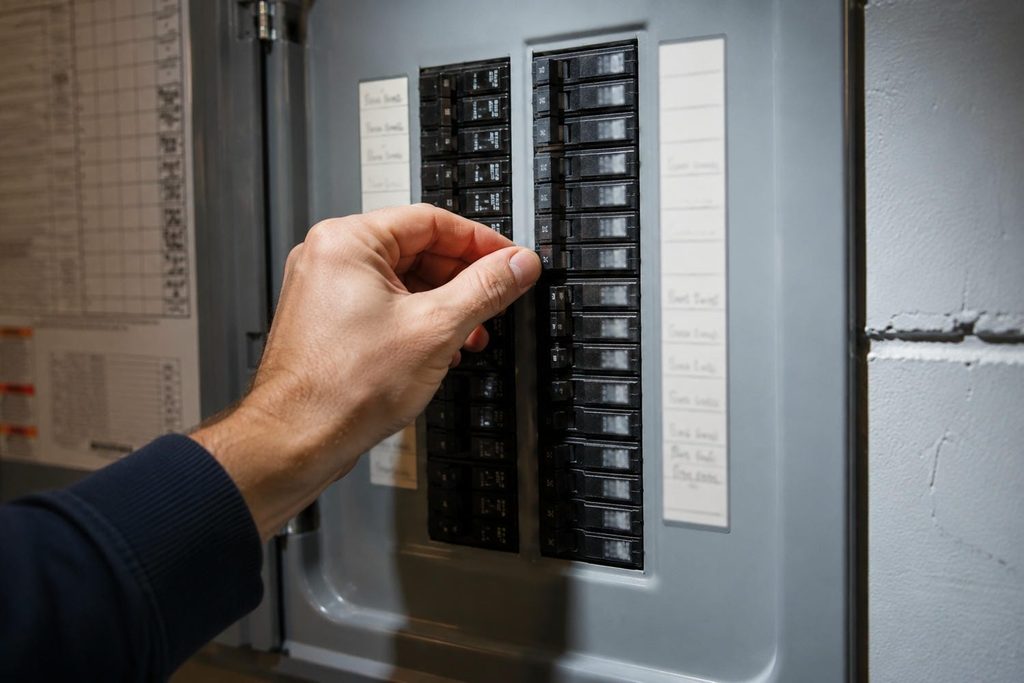
A breaker is a reporting device. It does not get moody, it does not wear out on a hot day, and it does not need coaxing. It trips because current went somewhere it should not have gone. And a central cooling system sits behind two of them, one indoors and one out, so finding the right one matters.
What a Tripped Breaker Looks Like When It Does Not Look Tripped
The condenser runs on its own double-pole breaker, two adjacent handles tied together, because it is a 240-volt load. Look for it labelled AC, A/C or condenser. Here is the catch: a tripped breaker often does not sit at Off.
It rests in a mushy middle position that reads as on at a glance, and anyone scanning a full panel will pass straight over it. So feel it as much as look at it. A tripped handle has slack in it compared with its neighbours, which sit firm. The indoor furnace or air handler is on a separate breaker, usually single-pole, and both of them need to be on before cooling will run.
How to Reset It Properly
Push the handle firmly all the way to Off first, then back to On. Halfway does not re-latch the mechanism, which is why a breaker nudged toward On can look reset and still do nothing. Then wait.
The compressor delay applies here too, so give the system a full 10 minutes before you draw any conclusion. If it holds and the system starts, you had a nuisance trip and you are done for today. It is still worth booking a look if that happens twice in a season.
If It Trips Again, Stop
Reset it once. If it trips again, leave it off and call. The breaker is not being fussy, it is reporting a fault, and every reset after that first one puts power straight back into the fault.
Ontario’s Electrical Safety Authority is blunt about a circuit that trips repeatedly: get a licensed electrical contractor to find out why. A breaker that re-trips the moment you push it means an overloaded circuit or an electrical hazard, and that needs professional attention now rather than on Monday. Leave the handle at Off so nobody else in the house has a try.
Step 5: The Condensate Drain, and the Float Switch If You Have One
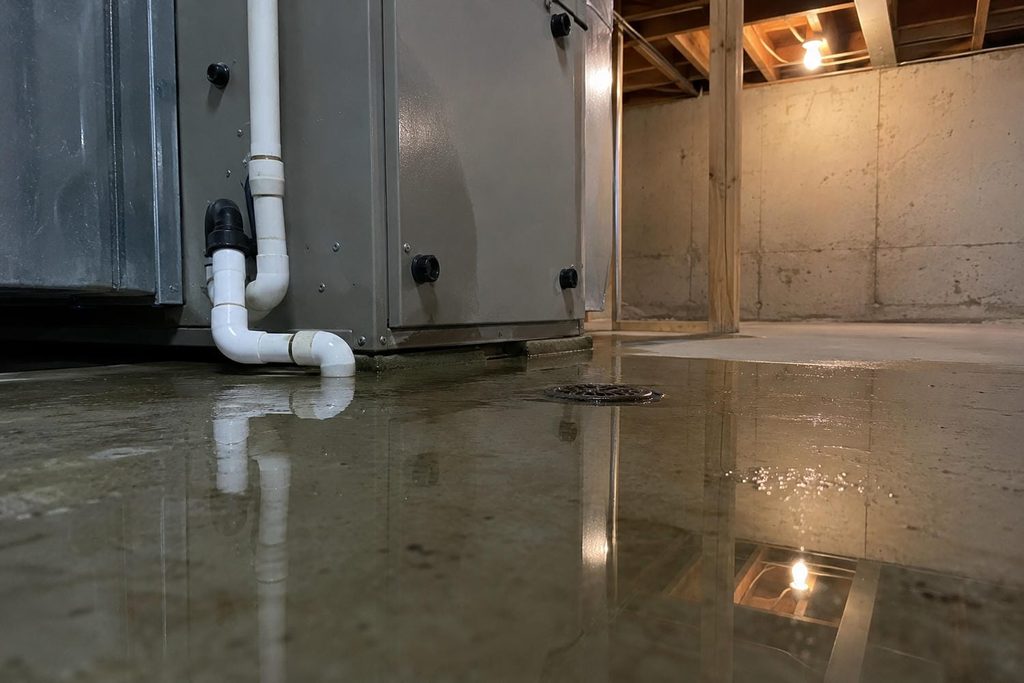
This one is quiet. A perfectly healthy air conditioner, shut down by water, with no other symptom to work from and nothing at the panel to find. If you have worked through four steps and everything passed, this is the next place to look.
How a Blocked Drain Can Shut the Whole System Down
Not every system has a float switch. If yours does, it sits at the drain pan or in the drain line, and its job is to stop the system rather than let water overflow into the house. When it trips, it does not just stop the indoor half. It shuts the outdoor compressor and fan down as well, which is why a tripped float switch looks identical to an electrical fault from where you are standing.
Drain lines clog with dirt, algae, debris and cobwebs, and they do it slowly. The tell is the timing: a system that quit suddenly in the heat of the day, after weeks of running fine, with standing water sitting in the pan.
What You Can Check at the Pan and the Line
Look for three things: standing water in the drain pan under the indoor coil, water on the floor near the furnace, and a drain line with nothing coming out of the end of it. Clearing the visible end of a drain line and wiping out a pan is reasonable homeowner work. Anything past that is not, and a drain that blocks again within a few weeks is telling you something worth acting on. A plugged condensate drain is not a small problem: it causes water damage and it pushes indoor humidity up, so the drain belongs on the maintenance list and not on a someday list. It is also the check most reliably done for you during a spring tune-up.
Symptom, Likely Cause, and What to Do Next
The symptom itself usually tells you which half of the chain is open before you check a single thing. A lit thermostat with total silence everywhere points indoors, to the low-voltage side. An indoor blower running with a silent outdoor unit points outside, to the disconnect or the condenser breaker. Read your own symptom first and you can often skip straight to the step that matters.
| What You Are Seeing | Most Likely Cause | What to Do |
| Thermostat screen is blank | Dead batteries, or the thermostat has lost its power supply | Fit fresh batteries. If it stays blank, the power feeding it has failed and that is a service call |
| Screen is lit, set to cool, and nothing happens anywhere | The low-voltage circuit is open: a blown control board fuse, an open door switch, or a tripped float switch | Reseat the furnace panel, check the drain pan, then book a technician |
| Nothing has run since the filter was changed | Blower door not seated, so the interlock is holding power off | Push the panel until it sits flush and latches, then wait 10 minutes |
| Indoor fan runs, outdoor unit is silent | Outdoor disconnect pulled or off, or the condenser breaker is tripped | Check the disconnect beside the condenser, then the double-pole breaker. Reset once |
| It quit on the hottest afternoon and will not restart | Condensate drain blocked and a float switch has opened | Look for standing water in the pan. Clear what you can see, then book service |
| The breaker trips again the moment you reset it | A fault on the circuit | Leave it off and call. Do not reset it again |
| Nothing electrical works anywhere in the house | Power outage or a supply problem | Check your local electricity distributor’s outage map before anything else |
| It restarts on its own after several minutes | The compressor protection delay doing its job | Nothing to fix. Wait 10 minutes before judging the system |
Where Homeowner Checks End and Licensed Work Begins
Every check so far has been a setting, a battery, a switch position, or a panel that is meant to be handled. Past that point the rules change. Ontario sets who can be hired to work on the electrical and refrigerant side of a cooling system, and what a homeowner has to file before doing that work themselves. That line is worth knowing before you open anything, because it is the difference between a check and a job somebody has to answer for.
What Is Not Yours to Open
Three things are not yours to open, and each one has a specific reason. The outdoor unit’s cover stays on, because the run capacitor inside holds a charge after the power is off, so “the power is off” is not the same thing as “it is safe”. The electrical panel is not a place to investigate; confirming a breaker position at the face of the panel is as far as that goes. And nothing involving refrigerant is homeowner territory, because in Ontario only a certified technician may remove, handle or dispose of it under the province’s refrigerant certificate rules.
While we are here, one correction worth making: low refrigerant does not usually stop a system from starting. It makes a running system cool badly, which is a different fault with a different fix.
The Licences Standing Behind One Basement Appliance
In Ontario, only licensed electrical contractors can be hired to do electrical work in a home, with some exemptions that include HVAC installers. That exemption is why a licensed HVAC company can legally do the electrical side of air conditioning work, and why you are not lining up two trades for one appliance. You may do electrical work in your own home, but you have to file notification with the Electrical Safety Authority and meet the electrical code.
Refrigerant is a separate certification again. And where the blower and transformer sit inside a gas furnace cabinet, the gas side is licensed separately again. That can be three sets of licences behind one appliance in your basement, which is why “check the switch, then call” is the honest answer rather than a sales line.
When to Stop and Call for AC Repair
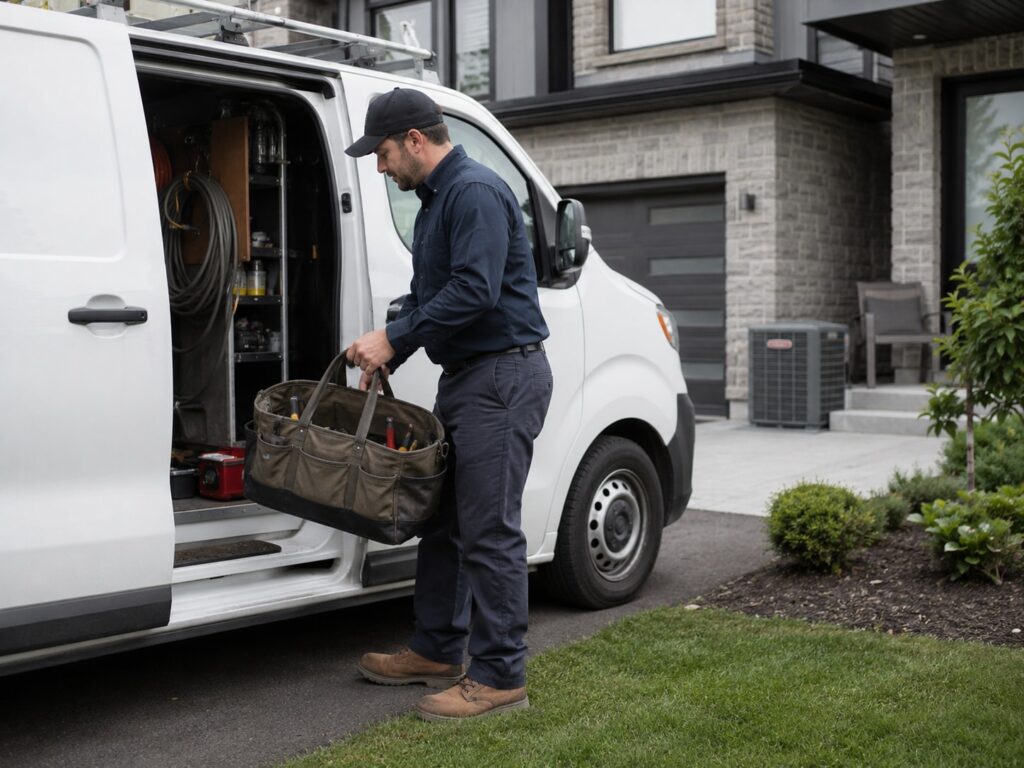
There is a point where more checking stops being useful and starts being risky. Knowing where that point sits saves you the guessing, and it saves the technician the first 20 minutes of the visit. Here is where the checklist ends and the meters come out.
The Signs That End the Checklist
Stop and call if any one of these is true.
- The breaker trips again after a single reset.
- There is a burning smell anywhere near the equipment.
- Water is leaking around the indoor unit.
- The low-voltage wiring outside looks chewed or damaged.
- The disconnect block is burnt or pitted.
- The system still will not start after every check here.
That last one matters most for your own confidence. An hour spent on the sequence and finding nothing is not a wasted hour: it has narrowed the fault down to the parts only a technician can safely test.
What a Technician Checks After This Point
Past the switches, the usual suspects are the capacitor, the contactor and the condenser fan motor. All three need meters to test and a safely discharged capacitor to touch, which is where homeowner territory ended two sections ago. A failed capacitor often leaves a unit humming without turning. A contactor can click and chatter without pulling in. A fan motor can seize outright.
The humming case is the clearest of the three, and a fan that hums but will not spin has its own walkthrough worth reading. If you have reached this point, book an air conditioner repair visit and tell us what you found.
What to Have Ready When You Call
Have six things ready when you call and the visit gets shorter.
- What the thermostat display shows, word for word.
- Whether the indoor blower runs at all.
- Whether the outdoor unit hums or is completely silent.
- The position you found the disconnect and the breaker in.
- Whether there is any water at the indoor unit.
- The equipment’s age, if you know it.
That short list tells the technician which half of the system to start on, and it stops the first 20 minutes of the appointment repeating the work you already did.
The First Week of Real Heat in Kitchener-Waterloo
Cooling equipment in this region sits outdoors for seven months and then gets asked to start, usually on the same afternoon everyone else’s is asked to start. That timing is not a coincidence, and it should change how you plan around it. It also changes what a dead air conditioner actually costs the people in the house.
Why the First Hot Day Is When These Faults Surface
The first real heat of the year is when these calls land. It is the first time all season the system has been asked to run, so anything that failed quietly over the winter announces itself now: the pulled disconnect, the chewed wire, the switch flipped back in April. Booking early in the day matters more that week than in any other.
And “hot” has a local definition worth knowing. In Waterloo Region a heat warning goes out when two days in a row are forecast at 31 C or higher with overnight lows of 20 C or more, or when the humidex is forecast over 40 C two days running. Indoors, temperatures above 26 C raise health risks for vulnerable people, and above 31 C are dangerous for anyone.
So in that week a dead air conditioner is a scheduling problem as much as a comfort one. Book early in the day, close the blinds on the sun side of the house, and keep air moving while you wait. And if someone at home is elderly, very young or unwell, get them somewhere cooled and say so when you book, because that changes how we prioritize the call.
Getting Ahead of It Next Spring
The fix for a first-hot-day no-start is a mild day in May. Take the cover off if there is one. Look inside the cabinet for nests and chewed wire. Confirm the disconnect is seated, put fresh batteries in the thermostat, then run the system in cool for 15 minutes and stand there and listen to it.
If something is wrong, you have found it on a Tuesday in spring instead of a Saturday in July, and it is a booking instead of an emergency. The whole-house rhythm is the same one we work to: the cooling check in spring, the heating check in fall, and filters kept clean year round.
When the Fix Is Bigger Than a Switch
Most of these calls end the same way: a switch back in position, a system that runs, and another season where nobody thinks about it. Some end differently. When a no-start turns out to be an aging unit on its third failure of the summer, the sensible conversation shifts from another repair to replacement, and that is a far better conversation to have in June than in the middle of a heat warning. Local Heating and Cooling has been doing this work across the region for over 10 years, from offices in Kitchener and Waterloo, and as an Authorized Lennox Dealer we will tell you plainly when a repair is the right call and when it is money spent twice. If the checks here have run out, get in touch with our Kitchener and Waterloo team, or read what is actually involved when the time does come to install a new air conditioner.
Frequently Asked Questions
Ten minutes of doing nothing. The compressor is held off for up to about 5 minutes after any stop, deliberately, so it never restarts against pressure it has not shed yet. The clock starts again every time the power is interrupted or the thermostat is changed, which is why cycling the breaker and watching for 90 seconds tells you nothing. Set it, walk away, and come back in 10 minutes.
No, and this is the most common wrong turn on the whole topic. A thermostat can run on its own batteries while the 24-volt circuit that carries its instruction down to the equipment sits open somewhere else in the house. A working display proves that the display works. It says nothing about the door switch, the control board fuse, the float switch, the indoor service switch or either breaker.
Yes, once. Push the handle fully to Off, then back to On, then wait 10 minutes for the compressor delay before you judge the result. If it holds, you had a nuisance trip. If it trips again, leave it at Off and call. Repeat resets put power straight back into whatever tripped it, and that is not something to work through by trial and error.
Look on the outside wall of the house, level with or just above the outdoor unit, for a small metal or grey plastic box about the size of a paperback. If it is not obvious, try around the corner from the condenser, or along the stretch of wall where the refrigerant lines disappear into the house. Inside is either a handle-style switch or a plastic block that pulls straight out. Both should be seated and switched on. If the block looks burnt or pitted, leave it exactly as you found it and book a technician.
If your system has a float switch, a full pan or a blocked line opens the control circuit, and that shuts down the outdoor unit as well as the indoor blower. Nothing else changes and no other symptom appears, so it reads as an electrical fault. The clue is when it happened: a sudden stop in the heat of the day, with standing water in the pan under the indoor coil.
Almost certainly nothing, beyond not quite closing the blower door. That panel is a safety interlock, and with it unseated the equipment has no power at all. Push it until it sits flush against the cabinet and the latch engages, then wait 10 minutes. If it starts, that was the whole fault, and it is one of the most common calls we take in the first hot week.
You may do electrical work in your own home, but you have to file notification with the Electrical Safety Authority and meet the electrical code. Hiring someone is different: that means hiring a licensed contractor, with exemptions that cover HVAC installers doing the electrical work on the equipment they install. For a no-start, none of this is triggered by checking a switch position or fitting fresh batteries.