
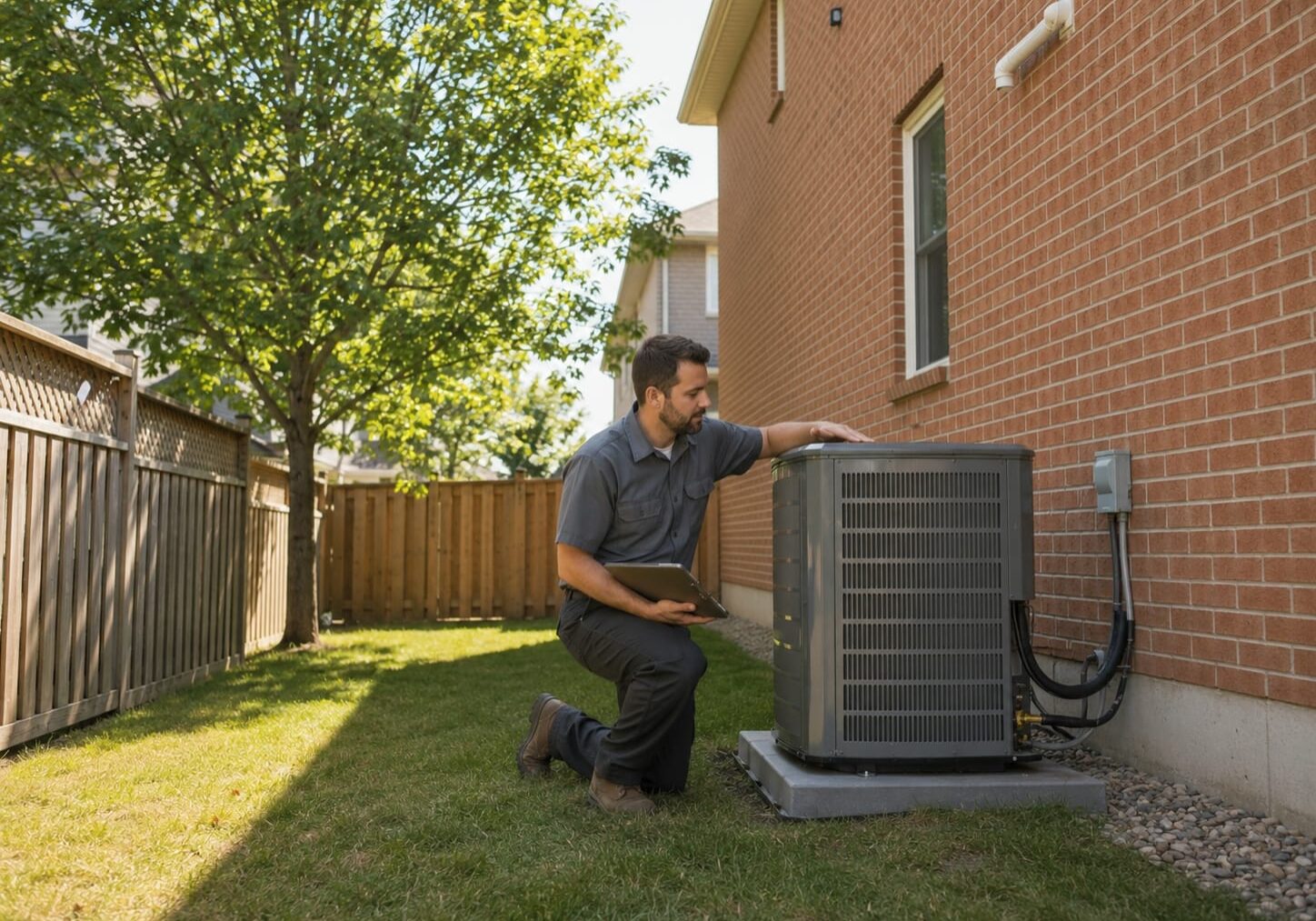
Replacing a central air conditioner in Kitchener or Waterloo rarely turns on a municipal building permit when the job is a straight like-for-like swap. It almost always turns on an electrical notification filed with the Electrical Safety Authority before the work starts. That distinction settles most of the confusion around an air conditioner permit in Kitchener-Waterloo, and almost every answer you will read online misses it.
An electrical notification of work is a filing that tells Ontario’s electrical regulator that electrical work is happening at your address, so it can be inspected. It is a separate document from a building permit, and neither one stands in for the other.
Permits confuse people because four separate authorities can touch one appliance: your city, the electrical regulator, the fuels regulator, and Ontario’s refrigerant rules. Which of them applies is decided by what the job touches, not by the word replacement, so two neighbours can install a new air conditioner the same week and end up with different paperwork. If you already know how long a central AC lasts here and yours is finished, permitting is the next thing to get straight.
The Short Answer: Two Permits From Two Different Authorities

Two authorities can have a say in your replacement, and they do not speak for each other. One cares about the building: its structure, its ducts, its heating system. The other cares only about the wiring that feeds the unit. Sorting your job into those two boxes is what turns a vague worry into a short list of questions.
The Electrical Notification Most Swaps Actually Need
Ontario’s Electrical Safety Code requires almost all electrical work to be reported to the Electrical Safety Authority through a notification of work. The person doing the work files it, whether that is a homeowner or a Licensed Electrical Contractor, and it should be filed before the work starts rather than after.
A condenser swap counts because the unit does not sit there on its own. It is disconnected from a dedicated circuit and an outdoor disconnect switch, and the new one is wired back to them. That is electrical work even when the wire, breaker, and disconnect all stay exactly where they were. So the swap that needs no building permit can still need a notification on file.
The Municipal Building Permit and What It Is Actually For
A building permit is the city’s tool for reviewing work on the building itself. For HVAC that means the mechanical system: ductwork, heat loss and heat gain sizing, structural work to accommodate equipment, and changes to how the house is heated. The city is not reviewing your brand of condenser or your SEER rating. It is checking that what you built into the house is safe, sized, and compliant.
Ontario’s own guidance for homeowners frames permits around renovations, additions, repairs, and changes of use rather than around appliance replacement. A permit follows construction, so the question for your job is whether anything you are doing counts as construction.
Why You Can Need Both, Either, or Neither
The Electrical Safety Authority puts it in one line: “Having a building permit isn’t the same as filing an electrical notification. You may need both.”
One does not cover the other, and having one does not excuse the other.
In practice it lands in one of three places. A straight swap on an adequate existing circuit usually means a notification and no building permit. A swap that changes the heating system, the ductwork, or the structure usually means both. A job that touches neither the building nor the wiring is rare enough that it is worth asking why. The word replacement decides none of this; what the job touches decides all of it.
Anything That Changes the Electrical Circuit
Some replacements quietly become new electrical work. A larger unit that draws more current needs a bigger breaker and possibly heavier wire. Moving the condenser to the other side of the house means a new run and a relocated disconnect. Each of those is new work, and each carries its own notification to the Electrical Safety Authority.
Everything in that paragraph raises the electrical requirement, not the municipal one. Rewiring a circuit does not by itself create a building permit, and pulling a building permit does not file your notification. The two travel on separate tracks, and the difference between reconnecting to a circuit that is already adequate and creating capacity that did not exist is the line that matters.
What Can Turn an AC Swap Into a Permitted Job
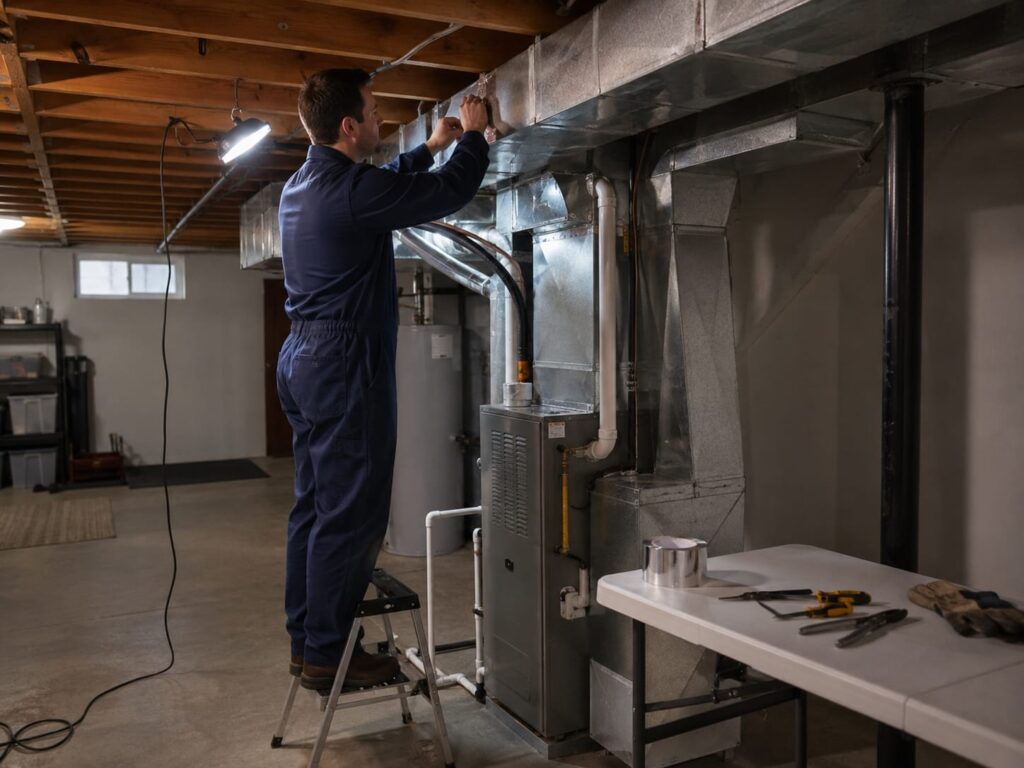
Three situations move a cooling job across the line into work a city wants to review. One of them Kitchener names outright in its published list. The other two are the ones our team sees convert a swap into a mechanical job most often in the field. Raise all three with your building division before the crew arrives, not after.
Your Heating System Changes
This is the clearest trigger on the page because Kitchener states it in print: “You need a permit to change your HVAC heating system.” The city also lists changing the heating source in an existing building, using electric baseboards swapped for forced-air gas as its example, among work that requires a building permit. Cooling is not what the city named. Heating is.
Replacing the furnace and the air conditioner together is the common version. Contractors often quote them as one project because the evaporator coil sits in the furnace plenum and the two share a blower. The moment the furnace is part of the job, the heating system is changing, and that is the trigger the city named.
The quieter version catches more people. A homeowner sets out to replace a tired air conditioner, and the quote that comes back is for a heat pump instead. That is the upgrade path we are quoting most often in Kitchener-Waterloo right now, and it changes the permit question completely, because a heat pump heats. Accepting that quote means a heating-system change, which is exactly the trigger Kitchener names in print. Nothing about the homeowner’s own plan changed, and yet the job has walked into the clearest permit case on this page.
New or Modified Ductwork
The evaporator coil is the reason an AC job reaches into the ductwork at all. It sits inside the plenum on top of the furnace, and the new coil is rarely the same physical size as the one that came out. Fitting it can mean cutting and rebuilding the plenum or resizing the supply trunk so the system moves the air the new equipment expects.
In our experience that is where a service job starts to look like construction. Cutting a new return, adding branches to feed a room that never had supply, or resizing a trunk changes the distribution system in the house, and a city reviewing mechanical work will generally want to see it. Where the line falls is not something either city sets out in a printed rule, so this one goes to your building division with a description of the actual work rather than the word replacement.
First-Time Install vs Straight Replacement
A house that has never had central air is not doing a swap. It is getting a new mechanical installation: a new dedicated circuit and disconnect, a new pad outside, a new line set through the wall, a coil fitted into a plenum that was never built to hold one, and sizing worked out from scratch. Cities generally treat them as different projects too.
Sizing is where the difference bites. With a replacement there is at least a previous unit to reason from. With a first install there is nothing, so the load has to be calculated, and heat loss and heat gain calculations are exactly what Kitchener names among the documents an HVAC permit application has to include. Sizing the unit correctly is what you live with for the next 15 summers.
How Kitchener and Waterloo Handle AC Permits

Neither city publishes a simple yes or no for a straight like-for-like swap, so the answer for your job comes from your city’s building division. What the two cities genuinely differ on is how they publish their rules and how they price the permit.
What Kitchener Publishes
Kitchener publishes a list of work that needs a building permit and a companion list of work that does not. Changing your heating system appears on the first list. A like-for-like central air conditioner replacement appears on neither, which means the city has not addressed the swap case in print rather than that it has cleared it. An absence on a webpage is not a ruling on your job.
Where Kitchener is precise is on process. An HVAC permit application there needs the application form, a Schedule 1 form completed by a BCIN-qualified HVAC designer, and heat loss and heat gain calculations prepared by a BCIN designer or a professional engineer. That last requirement tells you something useful: when Kitchener reviews a mechanical job, it reviews the sizing, not just the paperwork.
What Waterloo’s Building Bylaw Says
Waterloo takes the opposite publishing approach. Its Building Bylaw 2021-078 says a building permit covers construction, alteration or structural repair of buildings and parts of buildings, including plumbing, heating, ventilation, air conditioning, sewage systems, farm buildings, designated structures and signs. Air conditioning is named directly, in the bylaw, with no qualifiers about scale.
That language cuts both ways. It is broad enough to reach an air conditioner replacement, and it is general enough that it plainly was not written about your condenser specifically. The practical consequence is not that every Waterloo swap needs a permit. It is that a Waterloo homeowner has a clear reason to phone the building division before the crew books a date.
Side by Side: Fees, Process, and What Each City Publishes
The two cities do not just charge different amounts. They charge on different principles. Kitchener sets a flat fee per residential suite, so a modest job and an elaborate one cost the same to permit, while Waterloo takes a percentage of construction cost, so the identical job gets a different bill on the other side of the city line.
| Comparison point | Kitchener | Waterloo |
| How AC appears in the published rules | Not named either way; the named HVAC trigger is changing the heating system | Named directly in Building Bylaw 2021-078 as work a building permit covers |
| Residential HVAC/mechanical fee | $95.00 per residential suite | 1% of construction cost for mechanical work independent of a building permit |
| Refundable component | $250 rebate fee, refunded when the final inspection is approved | None published for mechanical work |
| Minimum permit fee | Not published on the residential permits page | $132 for any permit application |
| What you submit | Application form, Schedule 1 by a BCIN HVAC designer, heat loss/heat gain calculations | Part 6 HVAC design at 6+ bedrooms; HVAC summary form for additions of 15% or more |
| Review timeline | 10 business days | 10 to 30 business days by project type; 10 for residential renovations |
| Starting work before the permit | Provincial offence provisions apply | Special Permit fee doubles the permit fee, with sliding relief between $5,000 and $67,000 |
Fees are current at the time of writing. Both cities update their schedules on their own cycle, so confirm the figure with your city before you budget.
Who Is Legally Allowed to Do This Work
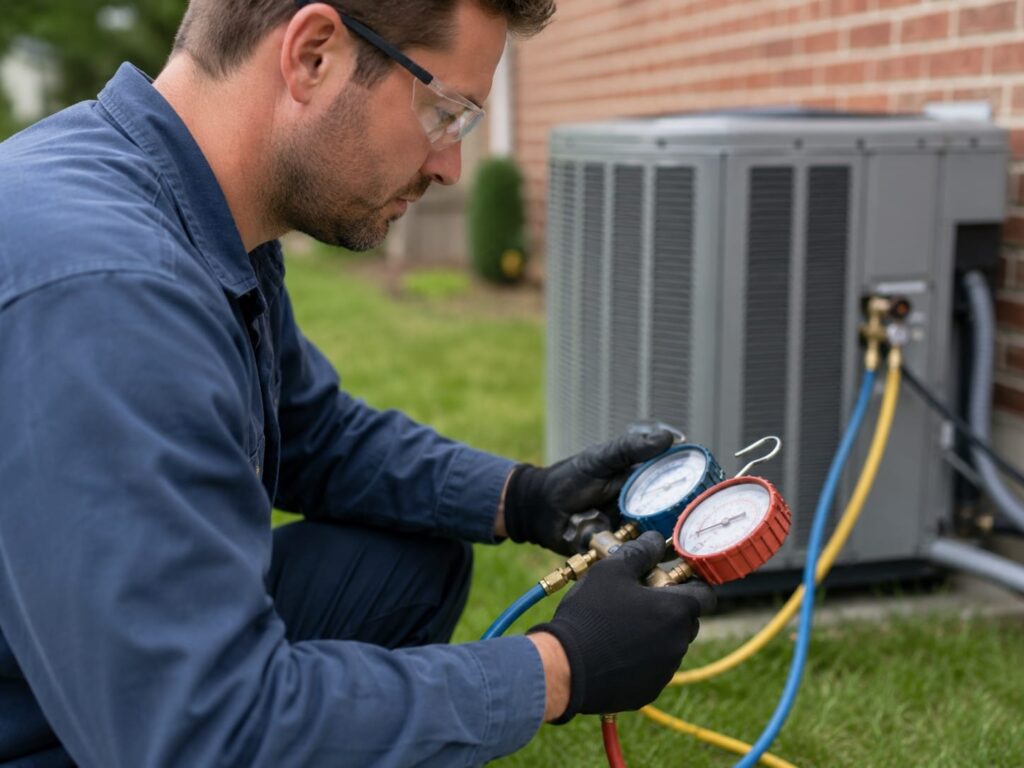
Permits and credentials are two different questions, and the credential question has firmer answers. A job can need no permit at all and still be work that only certain certified people may legally perform. Licensing and refrigerant rules bind either way, and they are the ones worth checking on your driveway.
The Compulsory Trade Behind Residential AC
Residential Air Conditioning Systems Mechanic is a compulsory trade in Ontario. Skilled Trades Ontario is clear about what compulsory means: to practise the trade legally a person must hold a Registered Training Agreement, a Provisional Certificate of Qualification, or a Certificate of Qualification. It is the ticket that makes the work lawful.
The scope is wide. The trade covers planning, installing, starting up, connecting, maintaining, servicing, repairing, testing, commissioning and decommissioning residential air conditioning systems and their components, including the electrical and electronic parts. The broader ticket, Refrigeration and Air Conditioning Systems Mechanic, known as 313A, covers residential central systems alongside commercial and industrial work. Either credential can cover a house; neither is optional.
The Refrigerant Certificate Nobody Mentions on the Driveway
Ontario requires a certificate to purchase and handle refrigerants, an Ozone Depletion Prevention card, and it is valid for 5 years from the date it is issued. A certified technician is required to remove, discharge, handle and dispose of refrigerants, and discharging them into the air is not permitted. That rule applies to your job on day one, before any new equipment is touched, because recovering the refrigerant out of your old unit is the first real step of every replacement.
So the refrigerant rule quietly answers the do-it-yourself question before the permit rules get their turn. It also explains why a system that keeps losing charge should be diagnosed properly rather than topped up season after season, because refrigerant leaks are a repair decision rather than a refill schedule.
Can My HVAC Installer Do the Electrical Connection?
This is the question readers most want answered, and the answer has two halves. In Ontario, anyone you hire to do electrical work in your home must by law be a Licensed Electrical Contractor, and you are entitled to ask for the ECRA/ESA licence number that proves the business may operate as one.
The second half is the exemption. The Electrical Safety Authority exempts certified refrigeration and air conditioning mechanics, and residential air conditioning systems mechanics, from holding an electrical contractor licence when the work falls inside their own trade scope. So a properly certified installer can make the connection on a straightforward reconnection. Push past that scope and the electrical contractor licence is back in play, which is why the practical move is simple: ask who is filing the notification, and get the answer before work starts.
When the Job Touches Gas
Gas work is a separate certification world from cooling work. If your installer has to touch the furnace, the gas line, or the venting as part of the project, that portion has to be done by a TSSA-certified technician working for a registered contractor, and TSSA is where you confirm both the technician and the company. Ask that question the moment a quote mentions the furnace, because a combined job usually crosses that boundary somewhere.
Fees and Timelines: What to Budget

Permit costs are small next to the equipment, and no one cancels a replacement over them. The schedule is the part that bites. A review window that lands in the wrong week of July is worth more attention than the fee itself, and both are worth knowing before you sign.
What Each City Charges
Kitchener’s residential HVAC permit fee is $95.00 per residential suite, with a $250 rebate fee that is refunded automatically once the final building inspection is approved. Waterloo charges 1% of construction cost for mechanical work taken independently of a building permit, and applies a minimum fee of $132 to any permit application. Flat fee against percentage fee is the whole difference: the same job priced two ways, and the gap grows with the size of the project.
Set beside the total, both numbers are rounding errors. It helps to see the permit line in the context of what a new AC costs in Ontario, because a permit fee that looks annoying on its own disappears into a project budget.
What the Electrical Notification Costs
The electrical notification is the cheapest document in the whole conversation. The Electrical Safety Authority notes that fees are typically under $100 for small residential projects, which puts it well below the municipal permit in most cases. For a straight condenser swap, that is often the only filing the job needs.
You may never see it as a separate line on your invoice. A Licensed Electrical Contractor normally files the notification as part of doing the work and absorbs the fee into the price. What is not fine is nobody filing it, so the number to ask for is not the cost, it is the confirmation.
How Long Approval Takes and When to Start Asking
Kitchener reviews building permit applications within 10 business days, then emails the applicant that the permit is ready to issue. Waterloo works to provincially mandated timelines that run from 10 to 30 business days depending on project type, with residential renovations processed within 10. Both are long in a heat wave.
That is the reasoning that matters more than the number. In late July, a 2-week review is the difference between a comfortable house and a rented portable unit in the bedroom. Which is why the permit conversation belongs in the quote stage, not the install week. Ask at the estimate whether a permit is expected, who is applying, and when the application goes in, and the schedule stops being a surprise.
What Happens If You Skip a Permit You Needed
The consequences are real, but they are not always the ones contractor marketing describes. Some of what circulates about insurance and resale is unsupported. What the province and the two cities actually enforce is more specific, and more useful to know.
The Provincial Fines
Ontario’s Citizen’s Guide to Land Use Planning sets the fine for building without a permit at up to $50,000 for a first offence for an individual, and up to $100,000 for subsequent offences. For corporations the maximum is $500,000 for a first offence and $1,500,000 for subsequent infractions. Failing to comply with an order from the municipal building department is a separate offence in its own right.
Those are maximums, not the going rate for a homeowner who replaced an air conditioner. The figures matter because they show the province treats permits as enforceable law rather than administrative preference.
Waterloo’s Doubled Permit Fee
Waterloo’s building bylaw carries the sharpest local consequence in this whole article. Where any work was commenced before the permit was issued, a Special Permit fee applies and the permit fee is doubled, with a sliding reduction where the original fee falls between $5,000 and $67,000. The bylaw names heating, ventilation, air conditioning, electrical, plumbing and drainage work specifically.
Kitchener does not publish a matching penalty, and that is a difference in published penalties rather than in tolerance. The provincial fines apply in both cities regardless.
Insurance and Resale After Unpermitted Work
The Electrical Safety Authority is direct about one version of the insurance risk: if an insurance claim links to work performed by an unlicensed electrician, the claim may be denied. Read that precisely, because it is a statement about unlicensed electrical work, not about unpermitted work in general. Beyond that specific case, how an insurer treats unpermitted work comes down to your own policy wording, so read the policy or ask your broker.
Resale is more practical than legal. Open permits and undocumented work turn up during a sale, and buyers’ lawyers ask about them. Keeping the permit, notification, and final inspection paperwork with your home records costs nothing. Explaining their absence to a buyer costs considerably more.
Whose Job Is the Permit?
Ontario states it plainly: it is your responsibility to get building permits and meet any legal requirements you need to renovate. Responsibility sits with the property owner, whatever was said in the driveway. Most contractors handle the application as a matter of course, and a good one does, but if it does not get filed the province is not looking for them.
Under Ontario’s consumer protection rules, any home renovation contract worth more than $50 has to be in writing. And the final price cannot exceed the original estimate by more than 10% unless you have agreed to new work. Both rules are reasons to have the permit named in the written quote rather than agreed verbally.
How to Confirm What Your Job Needs
Seven steps settle this for almost any replacement, and they take one afternoon of phone calls.
- Write down exactly what is changing: the unit only, or the ducts, the circuit, the location, the heating system, or the fuel type.
- Call your city’s building division with that list in front of you and ask whether the job needs a building permit.
- Ask your installer who is filing the ESA notification of work, and on what date.
- Ask which credential covers the electrical connection on your specific job, and who holds it.
- Get the permit number and the notification number in writing before any work starts.
- Keep the final inspection paperwork with your home records, where you can find it in 10 years.
- Check that your written quote names the permit, says who pulls it, and says who pays for it.
Steps 2 and 3 are the two that actually decide the answer, and they are the two most often skipped. A five-minute call to your building division with a clear description of the work is worth more than any general article, because the city is the only body that can rule on your job.
Related Reading
Three companion guides go deeper on the parts of a replacement this article only touches.
Budgeting the job: what a new AC costs in Ontario puts the permit fee in proportion.
Getting it right: choosing the right size air conditioner for your home is the decision a permit review actually checks.
Deciding whether it is time: how long a central AC lasts here tells you if you are replacing early or late.
Getting the Permits Right Without Making It Your Job
The permit question is really a competence question. A contractor who raises it before you do, tells you which document your job needs, and puts it in the written quote is showing you how the rest of the work will go. One who waves it off is showing you that too.
Local Heating and Cooling has run offices in both Kitchener and Waterloo for over 10 years, which means we deal with both building divisions regularly rather than occasionally, and we have been named a HomeStars Best of Award winner 5 years running. If you are weighing a central ac installation this season, we will tell you plainly which permits and notifications your job needs before you commit to anything. Talk to our team about your replacement and we will walk you through it.
Frequently Asked Questions
A few questions come up on almost every quote call.
Neither city publishes a simple yes or no for a straight like-for-like swap, so the answer comes from your city’s building division for your specific job. Waterloo’s building bylaw names air conditioning directly among the work a building permit covers. Kitchener’s published list of permit-required work names changing your heating system, not replacing an air conditioner. That is a difference in what each city publishes, not a difference in what they require, so describe your actual job to the city and let them rule on it.
Yes. A heat pump heats as well as cools, so installing one is a heating-system change, and changing your HVAC heating system is exactly the trigger Kitchener names in print. The permit question shifts the moment a heat pump appears on the quote. Treat a heat pump quote as a signal to call your building division before you sign, and expect the electrical side to need attention too, since heat pumps often draw more current than the AC they replace.
It is the filing that tells the Electrical Safety Authority electrical work is happening at your address, and the Ontario Electrical Safety Code requires almost all electrical work to be reported this way. The person doing the work files it: a Licensed Electrical Contractor on a contracted job, or the homeowner on genuine do-it-yourself work. It should be filed before the work starts. On a normal AC replacement your contractor handles it, which is why the useful question is who filed it and when.
You may do electrical work in your own home, but you must file a notification of work with the Electrical Safety Authority before starting, and only you may do it. Friends, family members and neighbours cannot perform electrical work in your home. The real blocker is not the electrical side, though. Handling refrigerant in Ontario requires a certificate, and a certified technician is required to remove, discharge and dispose of it, which rules out the recovery step on every replacement.
Kitchener charges $95.00 per residential suite for a residential HVAC permit, plus a $250 rebate fee that comes back to you when the final inspection is approved. Waterloo charges 1% of construction cost for mechanical work independent of a building permit, with a minimum fee of $132 on any permit application. The electrical notification is separate and typically under $100 for small residential projects. Both cities update their fee schedules, so confirm current figures before you budget.
Call your building division and sort it out rather than hoping it passes. In Waterloo, the building bylaw applies a Special Permit fee where work began before the permit was issued, doubling the permit fee, and it names air conditioning work specifically. Kitchener does not publish a matching penalty, but the provincial fines for building without a permit apply in both cities. Responsibility sits with you as the property owner, so file sooner rather than later.
Yes, and this is the cleanest trigger. Kitchener states that you need a permit to change your HVAC heating system, and a furnace replacement is a heating-system change no matter what the cooling half of the quote says. A combined job also usually brings gas work into scope, which needs a TSSA-certified technician working for a registered contractor. So treat a furnace-and-AC quote as a permitted job until your building division tells you otherwise.